

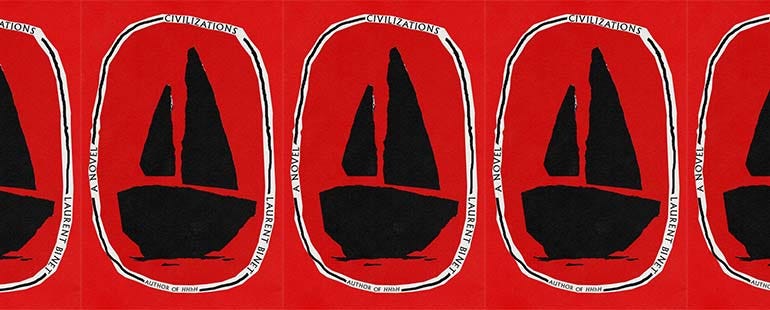
ADH: Welcome back to our month-long, two-person book club in public. Your interlocutors are myself, speculative fiction writer Andrew Dana Hudson (preorder my upcoming novel Absence here), and Lizzie Wade, a Mexico City-based journalist and author of the book APOCALYPSE: How Catastrophe Transformed Our World and Can Forge New Futures and The Antiquarian newsletter. The last two weeks, we discussed the first half of French author Laurent Binet’s fascinating book Civilizations: A Novel (translated into English by Sam Taylor), which featured errant Vikings spreading germs, steel, and horses throughout the Americas, Christopher Columbus’s swift defeat at the hands of well armed Cubans, and the Inca emperor Atahualpa discovering Europe and making a splash in the fractious politics of this “New World.” This week, our final installment, we’ll cover the rest of the book, which sees Europe remade — politically, religiously, agriculturally — by wealthy colonizers from across the Ocean Sea.
There’s a lot in this second half of the book: various conquests and political maneuverings and marriages and assassinations; epistolary exchanges between Erasmus and Thomas More; the Ninety-Five Theses of the Sun and other new legal doctrines; invasions by Mexican pirates in league with England; and eventually the death of Atahualpa in Florence at the hands of Lorenzo de Medici. The novel concludes with a coda section following the adventures of Don Quixote author Miguel Cervantes (along with a few other contemporary notables) across the vastly altered landscape of mid-late-1500s Europe.
So rather than try to cover all that in order, let’s just popcorn around. Lizzie — what caught your eye?
Lizzie: Not only does this section cover a lot of ground, it includes so many different formats. There’s the More-Erasmus letters (in which we find out Henry VIII converts to the religion of the Sun in order to simply have multiple wives, lol) and this world’s Ninety-Five Theses that you mention, but also other letters between Higuénamota and Atahualpa about the Mexica invasion; excerpts from an epic poem called The Incades based, I think, on the Portuguese epic of exploration and discovery called The Lusiads; and the whole last Cervantes section (which frankly confused me so let’s come back to that).
The legal documents and structural (!) changes Atahualpa makes to his new empire mostly sound…really good? He fully embraces his conquest allies (the previously outcast Moors, conversos, witches, etc); replaces taxes, rents, and the remnants of feudalism with periodic state labor requirements; and introduces new agricultural technology to make Spain more prosperous than ever. These policies give us a better look at the inner workings of the Inca empire than Atahualpa’s flight from the Andes did.
The Inca empire ran on the relocation of people and the centralized redistribution of resources, or at least that’s been the traditional archaeological and historical understanding of it. The Andes had a long history of political authorities using feasts to collect and redistribute resources. The Inca empire perhaps took this to a more authoritarian place than its predecessors, and it certainly had a wider reach. Imperial roads ran throughout the Andes and connected communities over vast distances. People from all over the place were brought to work at Machu Picchu and presumably other imperial estates. Entire communities could be relocated for the empire’s benefit, and perhaps to undermine any resistance they might have been able to mount at home. (The Spanish empire later employed the forced migration strategy of “reducciones” to break up Indigenous communities.) Corvée labor on state projects was mandated. The bodies of sacrificed children are found, still frozen, on mountaintops far from where they grew up.
But compared to the feudal inequality of Europe, which Atahualpa and company consider to be an inexplicably terrible political strategy, Inca-style (mostly) benevolent dictatorship comes off as almost progressive. Atahualpa doesn’t really do extractive colonialism either, mostly because Europe is so poor compared to Tawantinsuyu — what is there to extract? Or perhaps it just seems like Inca conquest is preferable because we live in a world where all the structural consequences of European feudalism + extractive colonialism have been allowed to play out almost unchecked. What would happen if the structural consequences of the now globalized Inca empire accumulated over centuries? (Is this what the Cervantes section is supposed to show us?)
I also want to ask a more basic question, speaking of all the different formats: Who is the narrator of the larger Atahualpa section? First person occasionally intrudes, like when the narrator says “I have before me, annotated in Atahualpa’s own hand [the Twelve Articles of the Alsatian Peasantry]” (pg 191). Who is telling the story here? Is it supposed to make us question the third person, “objective” telling of the Inca arrival and conquest? Can we trust anything we’ve read up until now?
ADH: I really appreciated those occasional breaks into the narrator’s personal world. They hint at all this being conveyed as a lecture by a more contemporary historian or chronicler, who has gathered up exhibits like documents or paintings to support this telling of events. They also remind me a lot of one of Binet’s previous books HHhH, sort of metafictional novelisation of the assassination of Nazi leader Reinhard Heydrich in Prague during WW2. (The title stands for “Himmler’s brain is called Heydrich.”) That book is told from the perspective of someone trying to write about these events, doing a bunch of research, comparing sources, having feelings about the characters, weighing how the story should be told. I think Binet is keen to remind us that history is constructed, built out of documents and artifacts, yes, but also out of the assumptions, agendas, norms, and grievances of the people doing the telling. Which is also one of the things Alternate History in general is so good at playing with.
I totally agree that Atahualpa’s reforms are generally an improvement on the feudal systems of the day. His agricultural policies aren’t just about taxes and labor but also include introducing crops from the Four Quarters, some of which, like corn and papas (potatoes), also became popular after contact in our timeline, but others, such as the highly nutritious quinoa, never caught on as civilizational staples. Meanwhile sheep were slaughtered, the landscapes they’d grazed bare turned back into land for growing crops. Some of these chapters that describe the sweeping results of Inca rule are so jam-packed full of little tidbits that I wish the book was actually a wiki page, so I could dive down into the details of, say, the elevation of Copernicus for his theory of heliocentric astronomy or Chalco Chimac’s hunt for Jesuit spies.
It’s interesting to consider whether the Inca’s land and agricultural reforms would end up blunting the impacts of the Price Revolution that, in our timeline, took place as Spain flooded Western Europe with American gold and silver, causing massive inflation that nearly collapsed the Spanish monarchy. Even though the Inca empire didn’t run on currency in the same way, Atahualpa recognized the utility of coinage and had Huascar send over lots of Inca gold with which to buy favor from various segments of the European aristocracy. But his way of dealing with the common folk seems much more of a direct distribution model of food, land, even two alpacas gifted to every peasant on their wedding day. Could we imagine this leading to a modern world in which basic needs are decommodified?
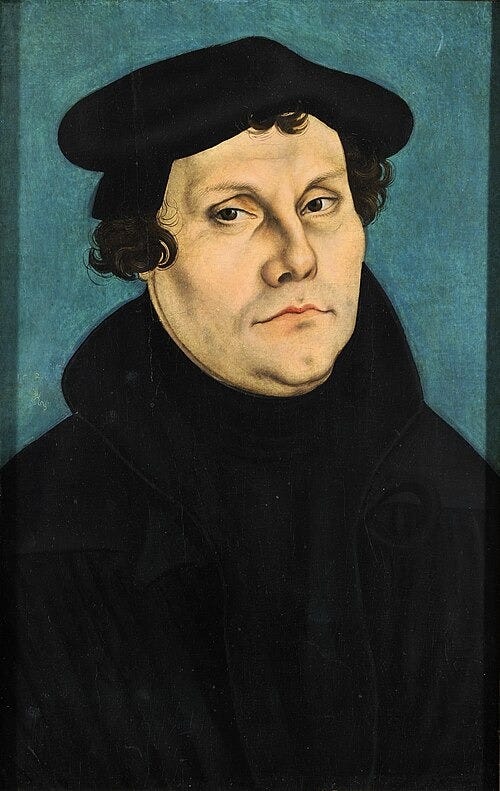
Anyway, it’s the need to turn Inca gold into legal tender that leads to Atahualpa dealing with the Fuggers in Germany, and eventually coming into contact with Luther. Binet’s depiction of Luther is pretty unflattering, painting him, in this later part of his life, as primarily obsessed with hating Jews more than actual theology or statecraft. As a Protestant preacher’s kid, this was way outside the understanding I’d grown up with of Luther as the great church reformer. Still, I think the depiction is well deserved, since Luther was extremely antisemitic, publishing a book blatantly titled On the Jews and Their Lies. Some scholars say he paved the way for the German antisemitism that led to the Nazis and the Holocaust.
Atahualpa sort of needs Luther’s blessing to win over the protestant German princes and continue his ascent to power. But the Fuggers also want him to kill Luther. In the end, we get the 95 Theses of the Sun, a really fascinating section that sort of tries to navigate and parse the clashing and melding of the Inca religion with Christianity. It covers mapping the trinity onto the Sun, Moon, and Thunder (can’t forget about Freydís spreading the cult of Thor all those centuries ago), the evils of indulgences, the rights of the poor, the ages of the world, quite a lot! But hey, the Reformation was a period in which doctrine was up for debate, as opposed to settled by institutional actors. Luther is enraged and in the ensuing riots is captured and dismembered by angry peasants. After which, Atahualpa finally becomes Holy Roman Emperor.
.jpg)
Lizzie: Luther comes off so badly in this book! I was also struck by his characterization as small-minded, petty, selfish, and unreasonable (in addition to antisemitic), as opposed to the stately, adaptable, and often generous Atahualpa. It strikes me as perhaps not all that “alternate” of a history in this case; anyone who feels driven to tear apart 1000+ year old religious doctrine and capable of replacing it with something **he wrote** was probably pretty unpleasant to be around. But perhaps I’m not giving Binet’s imagination enough credit here, now that the story is more situated in European history, about which we’re used to knowing all the details, or at least assuming it’s possible to know all the details with enough research.
That “wiki” feeling perhaps explains why I felt a bit bogged down by the second half of Atahualpa’s section. I admire Binet’s ability to evoke a sensation of believable historical density — it really does feel like he could spin a different novel out of almost every sentence — but I can’t say he made me care more about the marriages and machinations of his Alternate History Habsburgs than I do about the real ones. (Although there’s another parallel between Charles Quint’s brother and Holy Roman Emperor in exile Ferdinand and a series of Inca emperors in exile that resisted the Spanish conquest for 40 years.)
This sense of encroaching tedium is the point, however, as Atahualpa has now firmly lost his first mover advantage. His strategies become more and more bounded by preexisting relationships and expectations; he’s remade the board, so he can’t turn it over anymore. But someone else still can: the invading Mexica army, led by Cuauhtémoc (who, in our timeline, was the last Aztec emperor, appointed during the Spanish-Aztec war after the deaths of Moctezuma and his brother Cuitláhuac). This part was thrilling, with built-in suspense as Higuénamota and Atahualpa exchange letters they’re not sure will reach the other in time, or ever. In the end, Atahualpa betrays his long-time French allies and joins forces with the Mexica, to bring Mesoamerican riches into the Cuba-Spain trade route.
As an Aztec obsessive, I was disappointed with how little we learn about their politics, culture, religion, and goals as compared to what we now know about the Inca or 16th century Europe. It’s all about human sacrifice with them in this book, as it usually (and unfairly) is. Those scenes were so over the top, bordering on offensive, but I’ll admit they also made me laugh with something approaching delight. There’s a barely alternate version of our history in which Cortés is sacrificed in Tenochtitlan, and I enjoyed seeing it enacted on the king of France at the Louvre. Or is this part supposed to read as horrifying, and I’m just too Aztec-pilled to recognize it?

ADH: I totally hear you about the somewhat over the top depiction of the Aztec, though it is funny that they built their human sacrifice pyramid in the Louvre courtyard, where today sits a big glass version. Higuénamota even mentions its “harmonious proportions.” Maybe this is a hint from Binet (who is French) that here he’s resonating with future French history, perhaps the violence of the Terror echoing back through time.
For me the big takeaway from the arrival on the scene of the Mexicans is that Binet is trying to parallel the careless audacity with which, in our timeline, Europeans divvied up the world. I think all the time of that scene in Shōgun when Blackthorn explains how the Spanish and Portuguese signed a treaty dividing up rights to claim and colonize the New World, and the look on the faces of the Japanese characters who, probably rightfully, view themselves as sitting at the top of one of the planet’s most sophisticated societies. Such a dehumanizing way to view the world, cutting it up like a cake to split between squabbling siblings, with no care at all for the millions of people living there.
As in our timeline when the shoes of colonialism were on the other foot, the dividing up of Europe between the Inca and the Mexicans had little to do with the needs and desires of the colonized peoples and everything to do with ensuring peace back home. In the end, for all his reforms to benefit the marginalized, Atahualpa still cares more about his original empire, the Four Quarters. One wonders how this plays out long term, if this toxic dynamic leads to a sort of Great Game that extends across the planet, treating places like India, Africa, China, and Japan like chess pieces. Will the Inca be better at recognizing the humanity of people in those places? Or will competition with the Mexicans pressure them to set such concerns aside?
To be honest I don’t find the death of Atahualpa that interesting. He goes to Italy and hangs out with Michaelangelo and decides he wants to bed his sister, Quisepe Sisa, who is married to Lorenzo de Medici. Lorenzo in turn plots the Inca’s demise. Atahualpa is killed, but Quispe Sisa stifles the energy of this would-be republican revolution with a rousing speech to the Florentine crowd. The lineage of the Sapa Inca and the power of his generals seems like it will continue as a driving force of Europe’s future. The section is fine, but kind of an arbitrary end to a great character, which, I suppose, is probably the point.
One thing to note about the Italy section is that Binet did enough research on this region and era to write a whole other novel, Perspective(s), an epistolary mystery featuring art and scandal and murder and Michaelangelo. I read it last year and liked it okay, though it didn’t blow me away like Civilizations.
After this, we turn to probably the oddest section of the book, a solid 35 pages following the (mis)adventures of Miguel de Cervantes, driven by various dangers and impulses and contingencies around the world the Inca (and Aztecs) have made. Cervantes, of course, is (in our timeline, and possibly still in this one, who knows) the author of the famous novel Don Quixote. We meet some interesting characters along the way, like Doménikos “El Greco” Theotokópoulos, one of the great standout figures of the Spanish Renaissance. There’s a sense of the world still continuing to unfold, irrevocably changed by this contact of civilizations. Armies and navies are clashing, and we get a glimpse of papal scheming (the Pope not really being a major figure in the Chronicle of Atahualpa). I love the conceit of it, but the whole thing kind of washes over me.
Thoughts on the end of the book, and, I guess, the book as a whole?
Lizzie: I appreciate wanting to give a sense of “the world still continuing to unfold” and the medium- to long-term consequences of Atahualpa’s conquest, but it would have worked better for me with a bigger time jump. As it is, it’s just a few decades; Lorenzo and Quispe Sisa’s son is ruling Florence. It’s not long enough to see any satisfying reversals or surprises. There’s still religious strife and state violence in the Fifth Quarter, but did we really expect there not to be, despite the 21st-century appeal of Atahualpa’s reforms and the Ninety-Five Theses of the Sun?
Going back to the Louvre echoes, what if we got to see this timeline’s version of the French Revolution, which could be an anti-colonial revolt against foreign Aztec rule, led by the descendants of the sacrificed nobility? Or what if we’d stayed in the 16th century but gone back to Cusco, or to Tenochtitlan, to see how becoming colonial capitals changes those places and the people who live there? Or what if we started this section with Cervantes landing in Cuba, rather than finishing the book there?
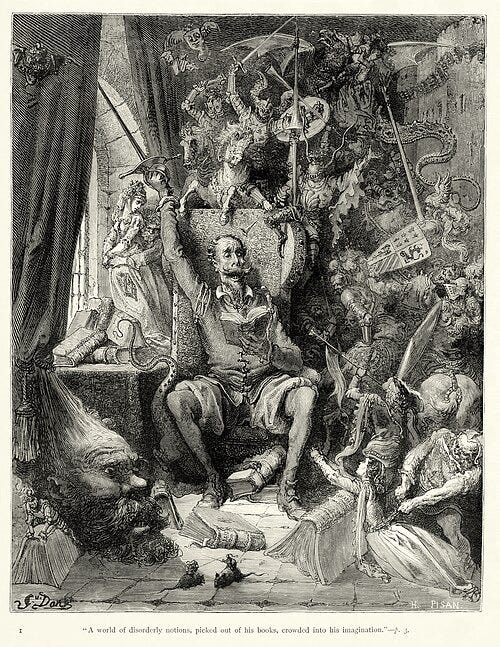
Mostly this section made me want to revisit Don Quixote. I read pieces of it in long-ago college classes, and even that unfairly tiny glimpse was enough to know that it’s an all-time banger. So funny and so postmodern, in all the best ways; not only was it the first novel, it somehow contains everything the novel would become and is still becoming. So I understand Binet’s desire to riff on it, and to assure us that it will still exist in this timeline, possibly as an even better version of what it could be in ours.
But of course “better” is a tricky word to use about history, or alternate history. Civilizations isn’t trying to argue that an Inca conquest of Europe would have led to a global utopia. If anything, as you say about the Inca and Mexica arbitrarily dividing up Europe, it shows that empire and colonialism are always mostly dark sides, no matter who’s doing the conquering. How consequences play out over centuries is never inevitable from the outset, or even logical (despite our attempts to look back and make them so), and there will always be features about where we end up that we wish were different.
What I appreciate most about Civilizations, then, isn’t the exact details of the alternate history it offers, but how it returns complexity and humanity to the genre of the colonial conquest story. Everyone, on every side, was a complicated person muddling through an incredible, unprecedented situation. Our version of colonialism strives to make us forget that truth, and in one way I’m sad it’s so much easier to see it in fiction than real history. But of course, that’s why we have fiction! To use our imaginations in a safe place, and then maybe learn how to use it in less safe ones.

ADH: The earliest known work of counterfactual history was written in the first century BC by Livy in his treatise on Roman history, Ab Urbe Condita Libri. While discussing the 4th Century BC, Livy offers his opinion on the apparently oft-debated question of how Alexander the Great would have fared against Rome, and in particular his contemporaries leading Rome’s military, had he lived to turn his conquests to Europe. Something about that question is way more interesting to me than simply contemplating Alexander’s biography.
I think alternate history fiction has a way of making history come alive. I’ll admit, I’ve not always been a huge history buff (though that’s changing as I get older), in part because there’s nothing to be done about the past. We can strive for justice, for understanding or recognition, but we can’t change what’s happened. For most of my life I’ve used the speculative and The Future/futures as a lens through which to try to make sense of the world, of how to derive meaning from a human life. When I let myself ask “what if?” about the past, that static series of events suddenly becomes dynamic. Choices and constraints have weight. Historical actors feel like they have agency. It gives me a vantage from which to consider the normative questions that I’ve long been preoccupied with, what ought to have happened, and, failing that, what should or at least could happen going forward.
Thank you everyone for joining us for this multi-week discussion. If you made it this far, please subscribe to both our newsletters, jump in the comments to share your own thoughts about AH, or pass this on to a history-loving friend. We’d love this to be more than a two-person book club.
Absence: A Novel comes out May 5th!
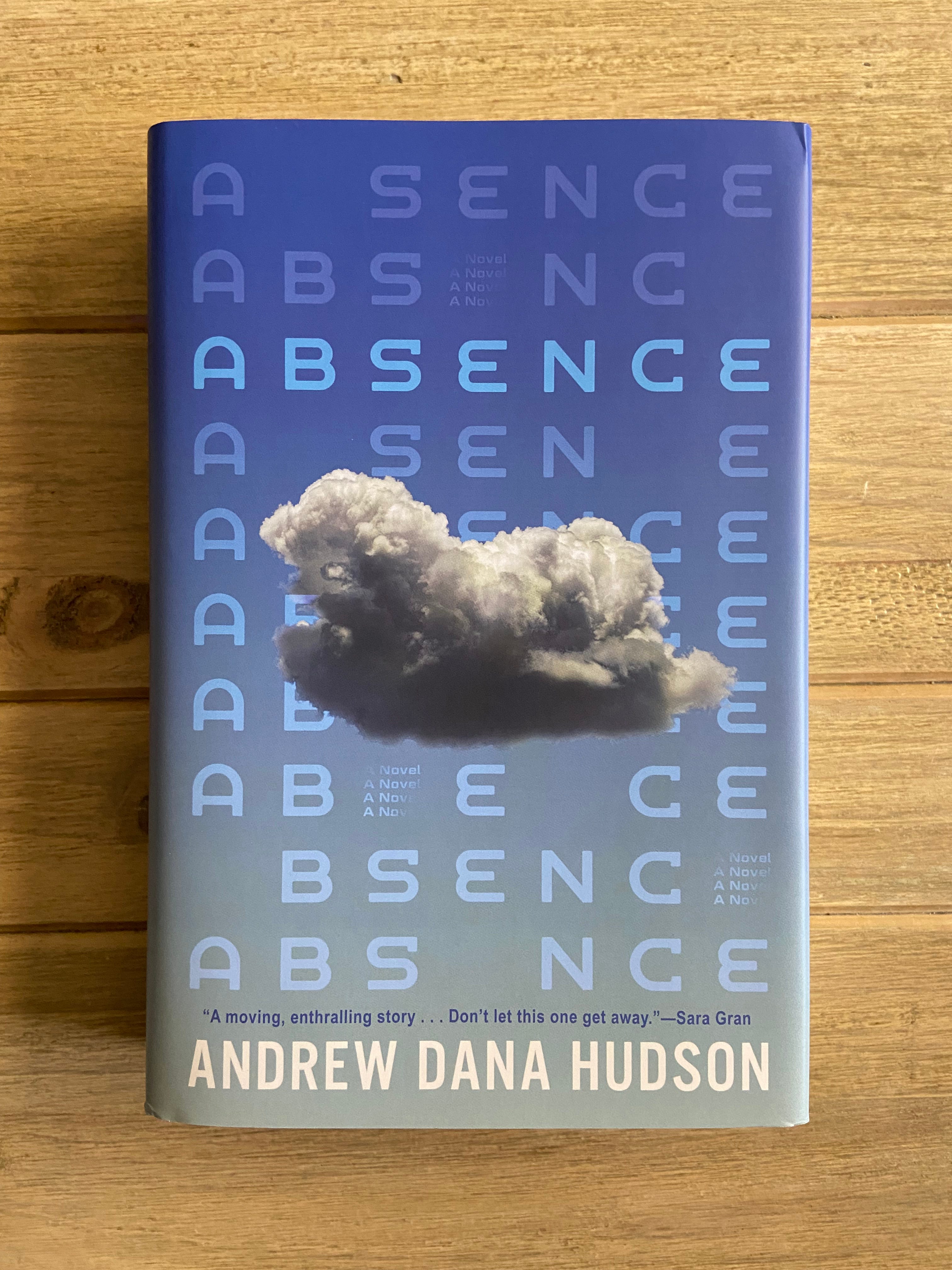
If you like the idea of using a speculative lens to make sense of the world and our search for meaning, than you should check out my upcoming novel! Absence comes out May 5th in print or ebook, as well as audiobook.
Book Tour
More dates are locking in for the Absence Book Tour! Here’s where I’ll be:
April 27, Phoenix, Changing Hands w/ Matt Bell
May 6, Scottsdale, Poison Pen w/ Hayden Casey
May 26, St. Louis, Left Bank Books w/ Scott Phillips
July 2, San Diego, Mysterious Galaxy w/ Jac Jemc
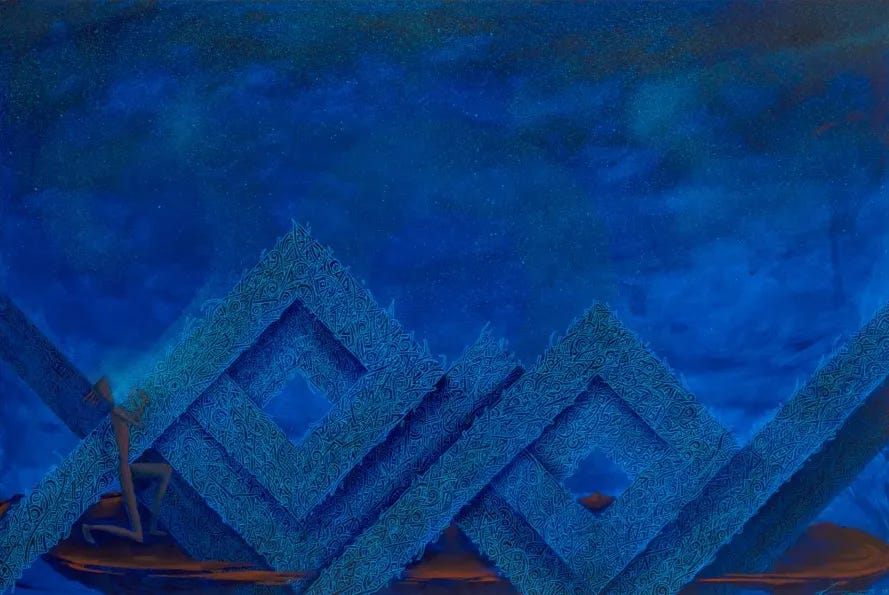
Art Tour: Stars Over Ce:dagi Wahia
There is no doubt that Luther is a complicated figure, but overall, I tend to come down on the positive. Luther's parents, particularly his father, were very punitive and abusive and grim. Luther grew up with a great fear of God as being punitive like his father and so Luther was deeply troubled by his sin. When his confessions stretched into 4 or 5 hours, his confessor finally told him to confess to himself. Faced with this grim and unhappy monk, his superior finally sent him to teach at a new university and to serve as pastor of a small, poor, congregation. Amazingly, Luther for the first time experienced love and admiration by his students and parishioners. He discovered that God is about Grace not punishment. So when the Vatican salesman came and took advantage of his parishioners, taking money that they did not have to give Luther was outraged and wrote his theses.
When he was threatened by the Pope, many others joined him including many nuns, one of whom requested to be Luther's wife. Luther found great joy in his marriage and subsequent children. He also took to the new invention of the printing press, and became the most widely known writer of his day.
However, there were time when Luther's deep depression came back, when he could not leave his bed, and when he had to go into hiding. During some of these times he did write hate filled words against Jews and against people who he felt were taking his ideas too far and were advocating anarchy.