

May was book tour (buy Absence: A Novel here). June was, well, a much needed rest. In that time I’ve had a few long-baking writing projects come out of the oven. So this newsletter will be a ranging preview of those efforts, along with a general update.
Reimagining Public Goods
Last year some ASU colleagues and I (complexity economist Joffa Applegate and media philosopher Sha Xin Wei) received a seed grant from the Lincoln Center for Applied Ethics to do a project on “reimagining public goods.”
Our idea was that, after centuries of privatization and enclosure, perhaps some of our collective economic and even spiritual woes could be addressed by shifting more of the economy back to a model of commons and public goods. After all, the market is very good at extracting the sorts of surplus value generated by cooperative production, but also reduces to numbers the human relationships at the heart of such activity. How do we find the balance between “market logic,” which maximizes surpluses, and something like “commons logic” or “relational logic” which prioritizes relationships and human wellbeing?
Joffa devised a graphic that we called the Social Activity Locator Canvas. Here’s one of the variations of the SALC:
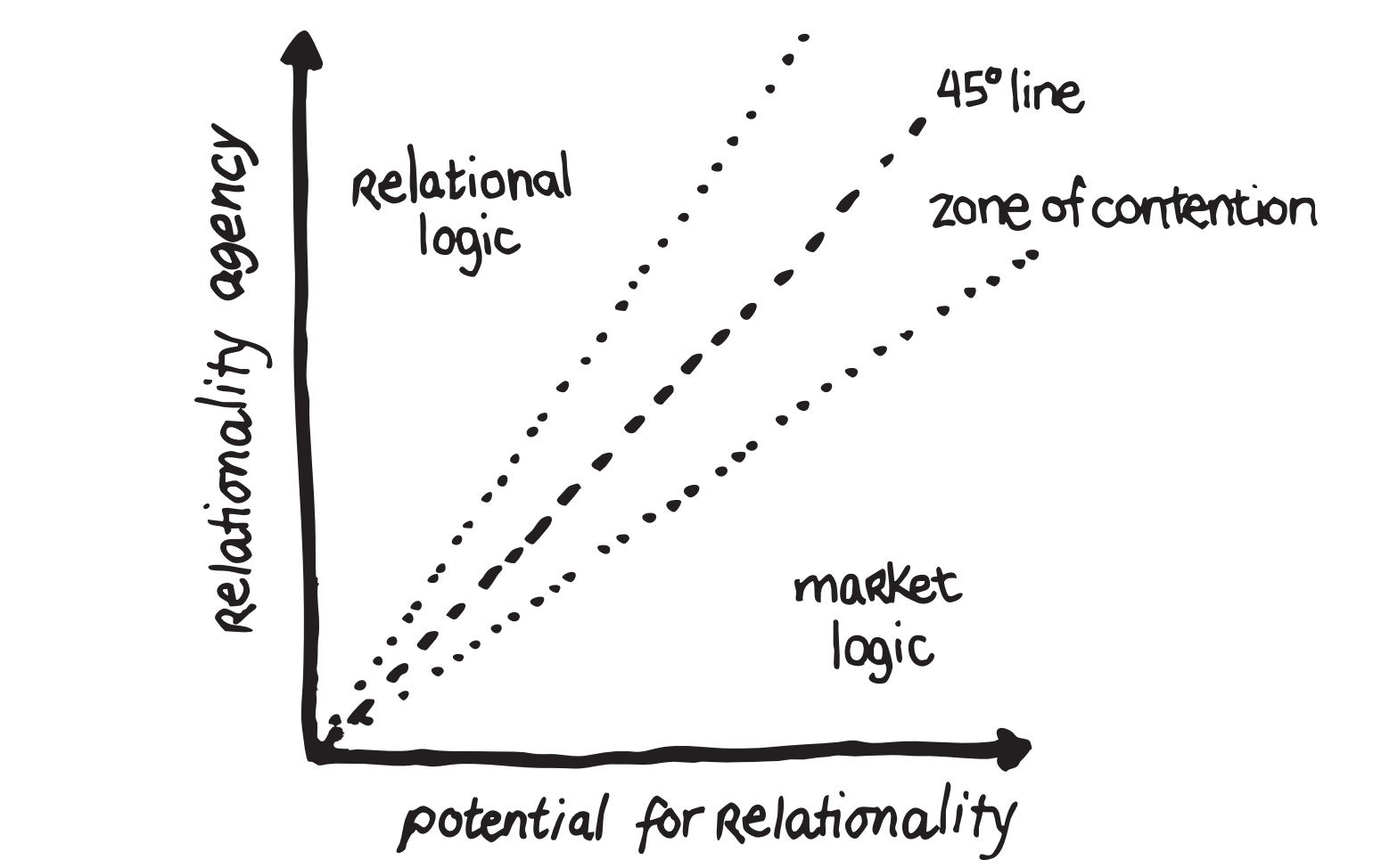
We have a white paper coming which expounds on some of this, but the key idea was to create a tool for thinking about the balance between two economics logics, and the contentions that might arise over which activities fall on which side. To exercise this tool, we organized a workshop back in January with a small number of wonderfully thoughtful people, hosted by our friends at the ASU Center for Science and the Imagination (CSI).
I facilitated this workshop, which was in part styled after CSI’s narrative hack-a-thons. After some group discussions and activities, three teams took on the task of imagining what it might look like to reorganize an aspect of the economy under a commons/public goods model: housing, food, or material goods. I was on the latter team, and our group spent the day teasing out the nuances and complexities of how a large scale lending library system for material goods could work.
We’ve compiled the results of these discussions into a trio of little electronic chapbooks. Each book — beautifully designed by Donovan Beeson — includes an explanation essay and a flash fiction piece, written by the spec-fic writer assigned to each group (Conrad Miszuk of the Kakos Industries podcast, CY Ballard of the Cosmic Mystery Club, and myself).
Here’s a snippet of my story, titled “High Intensity Stacks”:
Kassie batted her eyelashes at Darryn, but he was preoccupied by the looming stacks.
“So much stuff,” he mused.
“Yeah, humanity sure has produced a lot of interesting, useful material goods over the years. Crazy to think that not so long ago people would have to buy something outright just to use it even once. Tools and toys and so on would just sit in warehouses, not helping anyone unless you paid a ransom.”
“Things still sit in warehouses, though,” Darryn pointed out. “Like here.”
“Sure, but a lot fewer nowadays. I read in the Postal Times that the lending economy is so efficient, a lot of those old warehouses have been turned into housing and museums and indoor skate parks. This one facility serves as high density storage for the whole city! Ah, here we go.”
With effort, Kassie hauled a plastic crate down from the steel shelving. She pulled out a sturdy looking machine: football-sized cylinder sitting on rollers atop a boxy electric motor. The kit crate also included a bag of rough-hewn geologic samples, a jug of distilled water, and a colorful instructional booklet.
“Voilà!” she said. “One Valentine’s Day rock tumbler for the gentleman.”
I’m quite proud of the particular innovation of explaining a utopian economic arrangement not to a tourist or schoolchild but to a clueless himbo.
Check out the Reimagining Public Goods chapbooks! And if you have thoughts, do let me know. We’re hoping to iterate and run a workshop like this again in the future.
ETCHwork Design Fictions Toolkit
A year or two ago, I started talking with University of Toronto social scientist Paula Rowland about applying some of my speculative fiction-based exploratory practices to her health policy research. Paula had been looking at the implementation of electronic medical records systems in Canadian hospitals and clinics. She had amassed, as part of a meta-analysis of academic papers, fascinating insights into how this change in technology had impacted various clinical workers and how they viewed their roles and relationships in the workplace.
We decided to try to apply this same lens to a new emerging technology, using generative AI to listen in on exam conversations and create notes for medical records, supposedly cutting down on the time medical providers spent charting. I wrote a trio of vignettes that imagined the deployment of this tech from three different perspectives: a nurse, a software developer, and a hospital administrator. Here’s a snippet from the nurse’s section:
It seemed like not so long ago that her job—heck, maybe everyone’s job—had been filled with tedious writing and clicking tasks. She remembered plodding through the health information system, the endless toggles and dropdown menus and text boxes, which must be juggled while giving attention to the patient, their body and words and history. These tasks, in so many ways, shaped the kind of care they’d been able to give and how she’d been able to make her presence felt in the clinic workplace. So she’d been optimistic and even relieved when the hospital had announced, with much fanfare, the rollout of a new AI system that would listen in on exam room conversations and generate summary notes.
But now it seemed to her that the time saved on tedious writing and clicking had been shifted to time spent on tedious reading and scanning for errors, for the AI was neither perfectly reliable nor particularly concise. Despite years of promises, the probabilistic math of large language models meant that there would always be a few hallucinations scattered through an AI’s output, a few confusions or offkilter assumptions. The company that developed the product the hospital administration had chosen claimed that the rate of “impactful errors” (whatever those were) was well below the regulatory standard for a healthcare setting. Supposedly that meant no double-checking was required, but that wasn’t Janice’s experience. After a patient came back with severe side effects from an AI-ordered prescription, she cut down on the features she took advantage of. After a doctor tersely chewed her out about mistakes in a transcribed blood pressure measurement, she started feeling paranoid about how the new system was warping her work
Now, we were somewhat scooped by The Pitt, but it was still super interesting to think deeply alongside another scholar about what this tech might actual mean for the practice of medicine, and in our society in general.
Many of us — teachers who have to grade AI-written papers, slush readers who must now pan for human-written stories amid the slop, anyone who has to parse a corporate executive’s emails for meaningful information — are starting to realize that LLMs often don’t save time and effort but rather shift it around, transmuting your annoying writing task into someone else’s annoying reading task. We will have to have a society-wide reckoning of norms about these tools.
My three vignettes were used as part of a larger toolkit featuring group activities and prompt cards that ask participants to think about how emerging technologies might impact different actors in the workplace.
Check out the whole project at ETCHwork here.
New Short Fiction: “Churn”
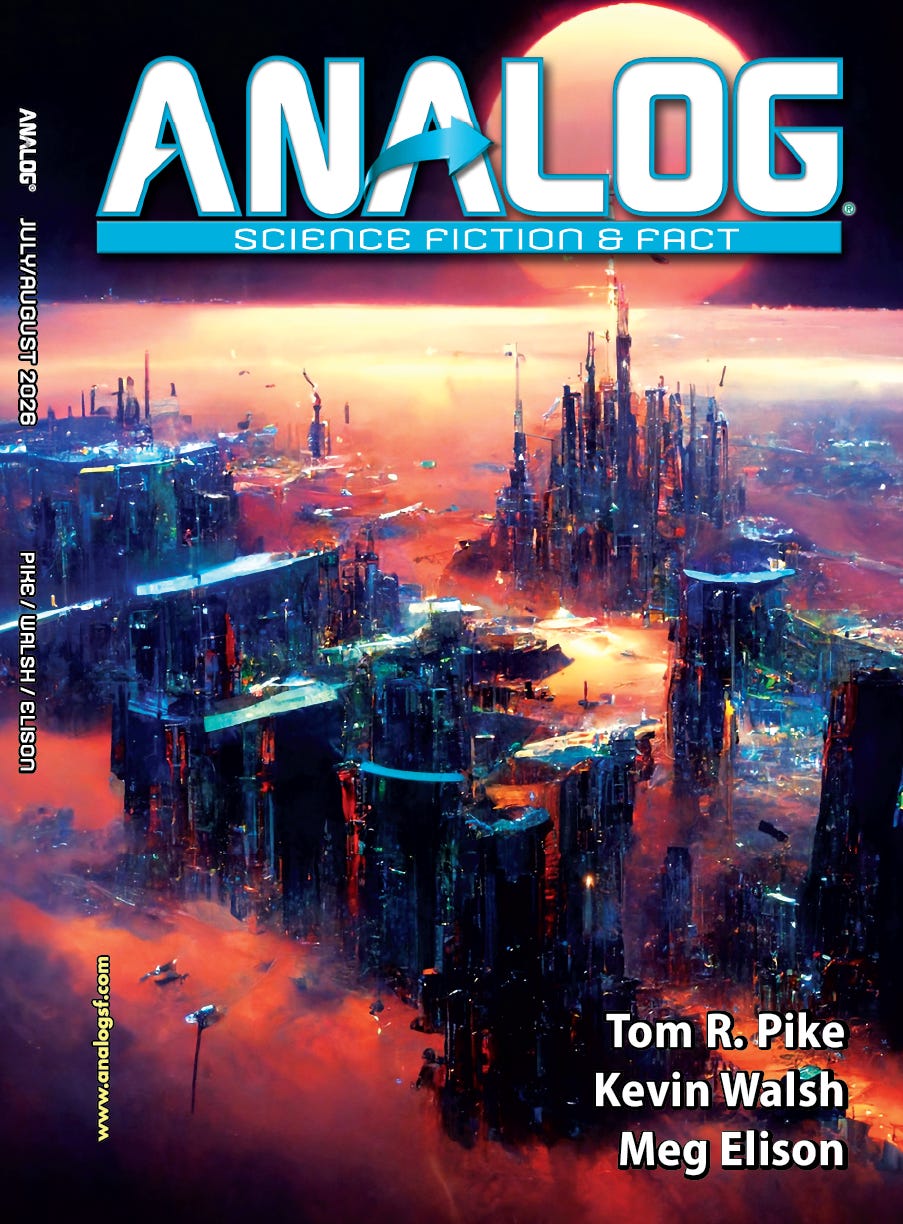
I also have a new short story out in the most recent July/August issue of Analog Science Fiction & Fact. The story is titled “Churn,” and it’s an odd one. Here’s the opening few grafs:
Pitt was a wallscreen baby and then a rotophone kid, going from touchcolor wonderland to kinkcord tug-of-war with his sibs. His teen years slid from tablet selfies to headset versing, left him burned out and nostalgic all at once. Which was normal. His whole cohort spun through the churn with a pleasant, passive cynicism.
Once he was of age, Pitt could participate in the great technocommunications democracy that year-by-year shifted the world from one platform or device to the next. Still a boy in spirit, he cast his first ballots on a lark, voting twice for paybooth and feeling shocked when he got it. To win, to see glass boxes go up on city corners, made him feel giddy and powerful all at once. But, truthtold, he hated the result. Making a call meant a trudge of stairs up from his basement apartment, and each time he rued his choice. Until, that is, he met his future wife in the halfrateday queue.
As usual he arrived at the booth sweaty and huffing, half-forgetting whom he’d wanted to talk to. No state for the polite chatter of the waitline. Tura was ahead of him, see-around familiar but touch-close for the first time. She was toe-tapping and direct, and she corrected the change he was fumbling with before he made it everyone’s problem. In thanks Pitt did a little cointrick he’d been practicing all season, and she laughed. By then he’d caught his breath enough to talk of the neighborhood and where they’d moved from, so the timepass went quickly, his heart beating double fast in his chest. Then Tura was up, and he marveled at how she worked the dialer, the poise with which she held the receiver with her shoulder, the picture of mediacool. When his turn finally came, he found her number marked in neat letters on the booth’s noteslate.
Soon after, the churn went to social feed handscreens, and he found they made him snarkhappy and goofynervous at the same time. He was the funniest he’d ever been, he was pretty sure, and he poured all that charm into wooing Tura, their textinches piling up yard-by-yard all day long, miles of riffs and ribbing and secrets and sweetnesses.
I first started this story in a fugue state while unable to sleep on a flight to Italy a couple years ago. I’d been chewing for a while on the notion that modernity had partly been defined by the frequent changes in the means of communications and media, from letter to telegram to phone call to text message, from phonograph to cinema to TV to video games. Would that transformation ever end, ossifying into a final form, and if it did, would the world still feel modern, or would it become dreadfully stagnant?
In the far future where Pitt lives, we’ve decided to just keep the party going, switching from one platform to the next year by year for centuries. But is that progress, or just churn? And what does it mean to live a life and raise a family in a world that never stops changing?
Check out “Churn” by subscribing to or picking up a copy of Analog.
Some Professional News
I finished my MFA at Arizona State University this past spring. Now I’m pleased to announce that I’ll be staying on at ASU for at least the next year as a clinical assistant professor. I’m stationed in the English Department, doing some curriculum development this fall and then likely teaching creative writing in the spring. However, I’ll be splitting my time working on a project with university affairs.
ASU has been an intellectual home to me for almost a decade now, and so I’m very excited to be embarking on a new chapter of that collaboration. I’m also excited, after a while spent as a semi-terminal graduate student, to be finally stepping into the role of academic. There’s so much I love about being in the world of higher education, where I get to have regular conversations with both seasoned experts and students encountering big ideas about our world for the first time. It’s a vantage I value a lot. So, glad to be here.
Our Shared Storm on sale 40% off!
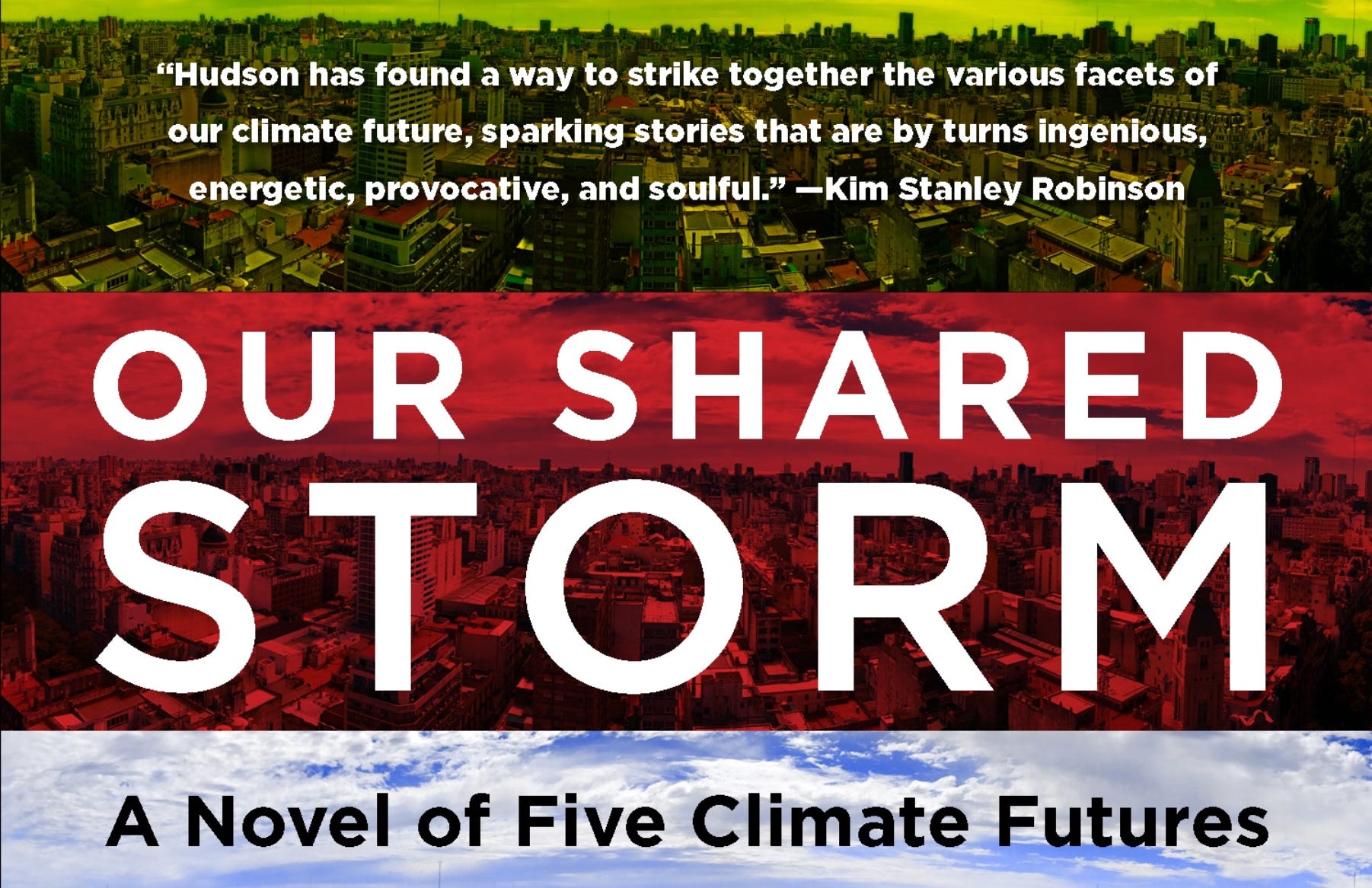
Fordham University Press is having their summer sale right now through the end of August, and my first book Our Shared Storm: A Novel of Five Climate Futures is one of the select books being offered at a 40% discount (plus free shipping on orders over $50). If perhaps you read Absence and want to check out more of my writing, now is your chance to get the paperback on the cheap.
Book Tour: San Francisco 8/13 w/ T.K. Rex
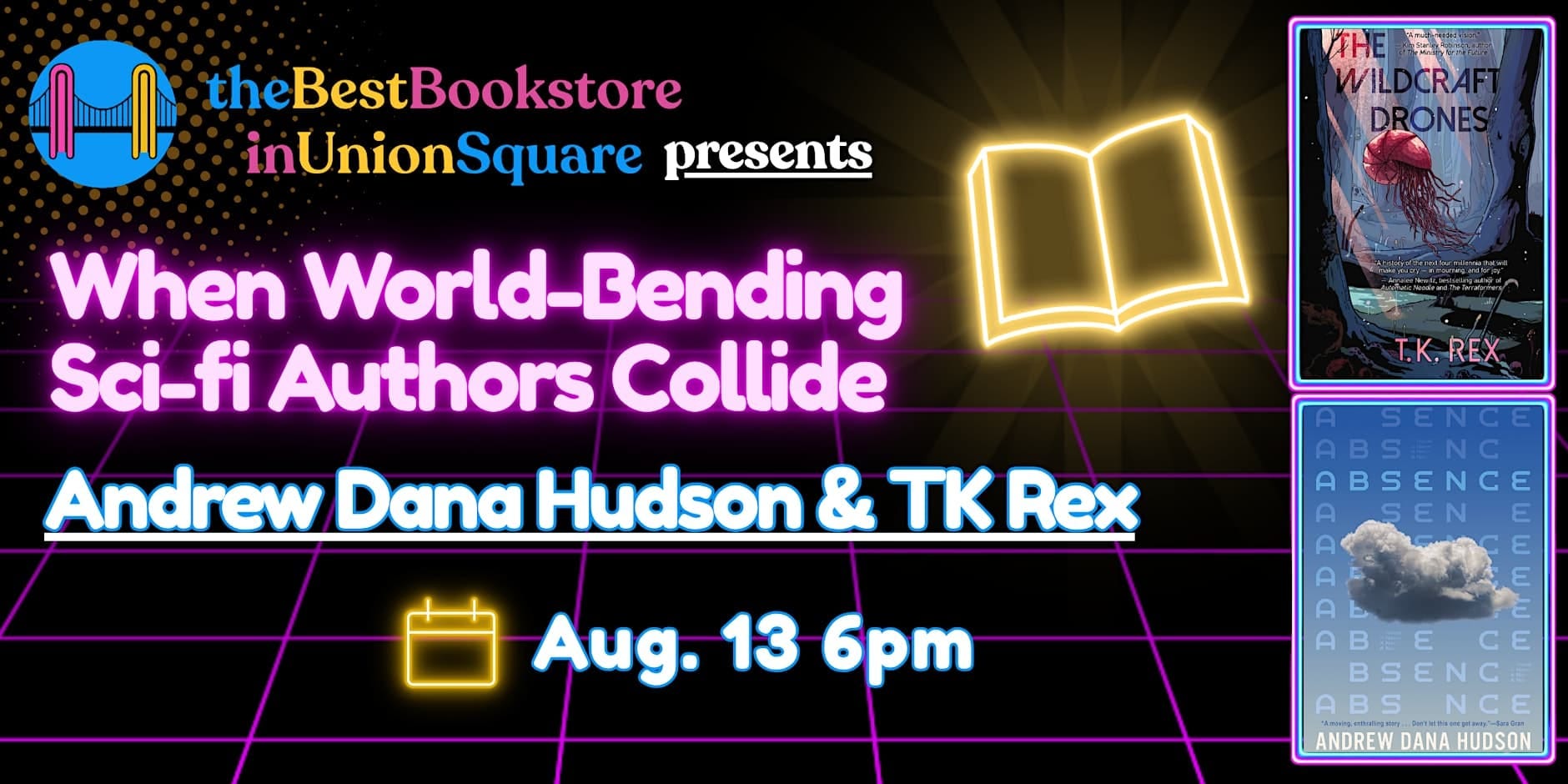
Meanwhile, in Absence news, next month I’ll be bringing my book tour to the Bay Area, where I’ll be doing a dual-book event at The Best Bookstore in SF’s Union Square with my friend T.K. Rex.
T.K. has also had a book recently come out, her wonderful debut story collection The Wildcraft Drones (Stelliform Press). I feel privileged to have read some of the collected stories in various forms over the years before the rest of the world got to enjoy them. Here’s the blurb I gave T.K.’s manuscript:
“Thoughtful and funny, tender and bracing, these stories (and comics!) weave together into a potent vision of the crises we face and the strange and beautiful futures we might build on the other side. An essential text for any solarpunk’s bookshelf!”
So on Thursday, August 13, likely in the evening, we’ll be having a public conversation about our two books and the ways they explore unfolding planetary disasters, social change, and the possibility and utility of hope.
Here’s the Eventbrite to RSVP!
Recommendations + Fellow Travelers
It’s a good year of books for those of us who were in the Clarion Ghost Class back the pandemic days. Along with me and T.K., my friend Jenny Williams has just released House of Liars. From the jacket copy:
Yellowface meets Her in this literary psychological thriller of motherhood, desire, and machines that might know us better than we know ourselves.
When struggling mother and failed novelist Anna Olin is invited to an exclusive residency on a remote island, it feels like an opportunity for artistic redemption. Alongside five other writers, including an old flame whose spark still smolders, she must finish her novel to compete for a million-dollar publishing contract. The catch? One of the writers is an AI.
I haven’t read it yet, but it sounds tremendous, and Jenny is a tremendous writer. So check it out.
Art Tour: Robot Stories by Akira Ikezoe
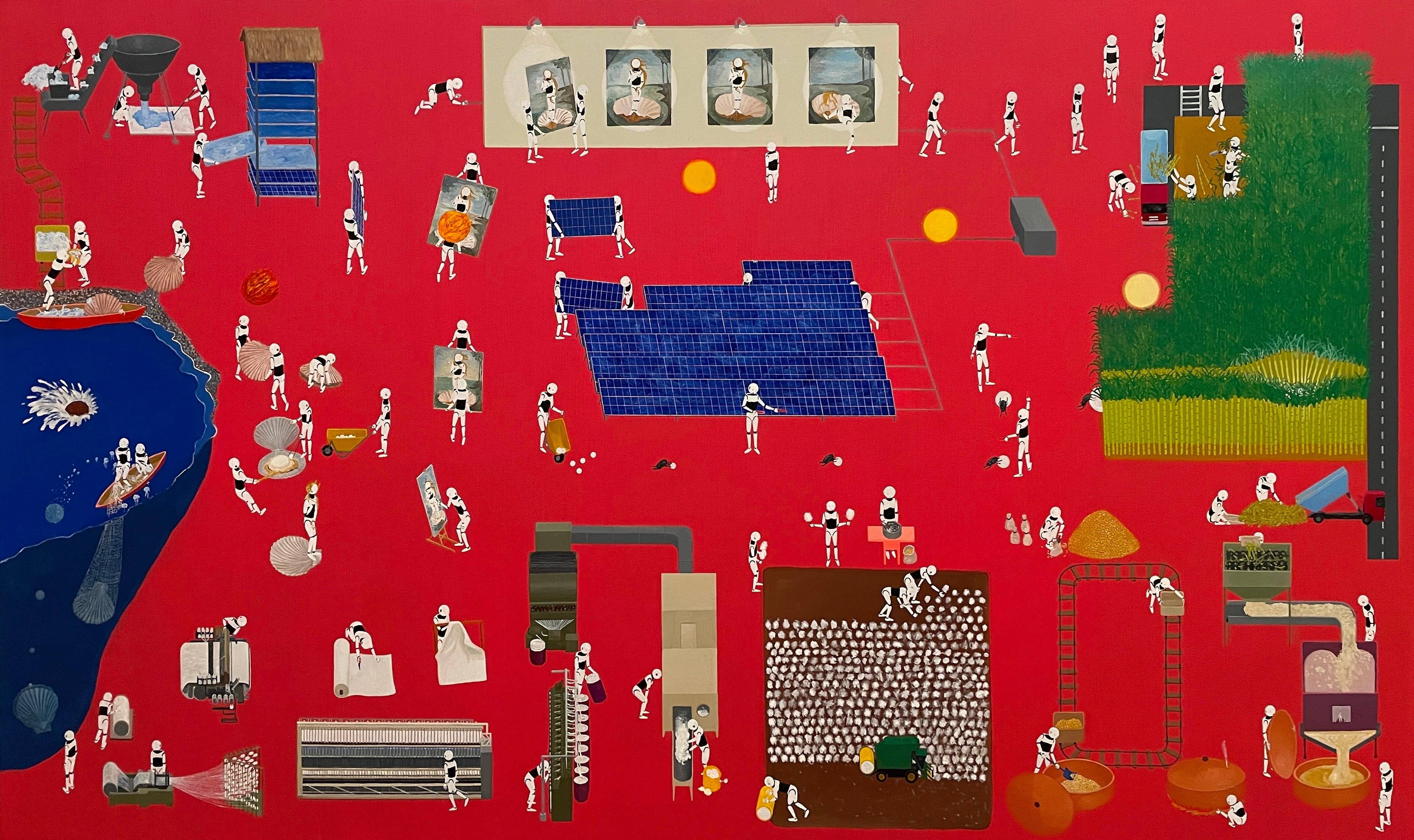
On the NYC leg of my book tour, we stopped at The Whitney, where I was enchanted by this series of paintings by Akira Ikezoe depicting scenes of amusing circularity. There’s so much to see and ponder in these paintings, labor and extraction and waste all entangled together. A highly recommended part of the biennial, if you get a chance to catch it.
Thank you for reading. If you like what you read or want to support my work, please consider buying a copy of my novel Absence, a twisty speculative thriller. And if you’ve already read it (thank you!!), consider leaving a review at Goodreads, Amazon, etc., or maybe just letting your local bookstore know you liked it.