

ADH: Hello and welcome to another collab post between myself, speculative fiction writer Andrew Dana Hudson (preorder my upcoming novel Absence here), and my friend Lizzie Wade, a Mexico City-based journalist and author of the book APOCALYPSE: How Catastrophe Transformed Our World and Can Forge New Futures and The Antiquarian newsletter. Last year we shared our written conversation about “thermochauvinism,” a coinage of mine that we expanded into a broader concept of “thermocolonialism.” Along the way, I got Lizzie to check out one of my favorite books I’ve read this decade, Civilizations: A Novel by the French author Laurent Binet (translated into English by Sam Taylor). Since this book is very much up both our alleys, we decided to have a sort of two-person book club in public about it.
(Readers, if you want to follow along, this first of three newsletters will cover the first two parts of the book, about the first fifty pages. We’ll be back next week with a discussion of the next ninety or so pages, and finish up with a part three that covers the rest of the book. And obviously, as C likes to say, spoilers ahead.)
Civilizations is an alternate history in which Freydís Eiríksdóttir leads a band of Norse settlers in Greenland on a long journey south, spreading germs, steel, and domesticated animals throughout the Americas. Centuries later, Christopher Columbus arrives in Cuba and quickly gets his ass kicked, dying a prisoner without ever returning to Spain. In the mid-1500s, amidst civil war with his brother, the Inca emperor Atahualpa flees to Cuba and learns the story of the people who came from across the ocean. Intrigued and without other prospects, Atahualpa sails east, landing in a Europe riven by the Inquisition and the Reformation. Through a series of unlikely but historically resonant events, Atahualpa conquers this “New World.”
I’ve read this book at least three times since I first picked it up in 2023, and I have a huge amount to say about it and the alternate history genre in general (my current novel project is AH). But for now I’ll pass it over. Lizzie, what did you think of Civilizations?
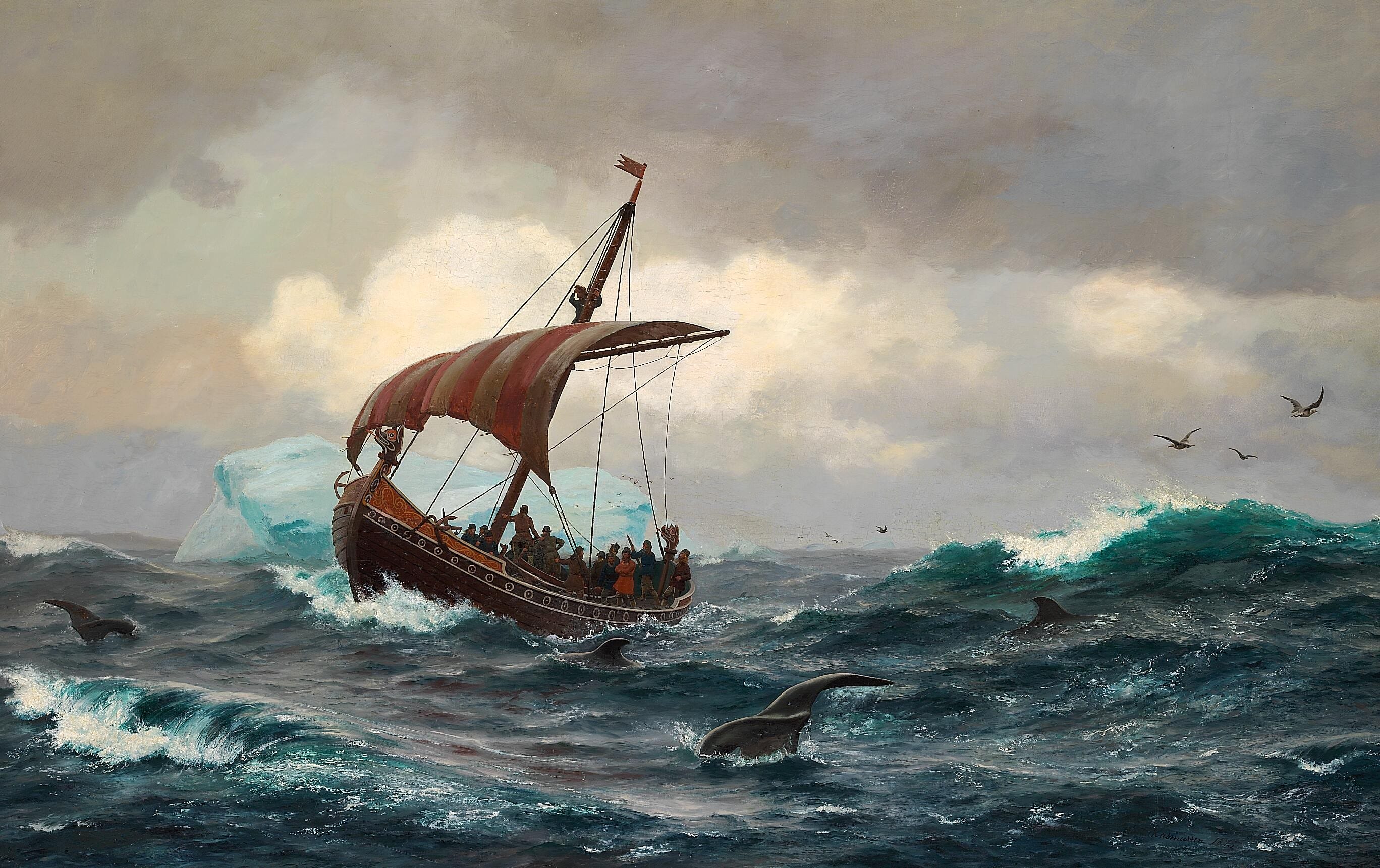
Lizzie: There is so much to talk about in this book! I loved, for the most part, the Viking section that opens the book. Freydís’s journey has a mythical quality, as she and her companions hop from Canada to the eastern U.S. (Virginia, maybe?) to Cuba to the Yucatán peninsula and finally to Peru and beyond, seeking a new home. The people they meet are often, but not always, generous, curious, and generally happy to have the newcomers around, until people start getting sick.
This section explores contact without colonialism, an alternate history possibility that endlessly fascinates me. Freydís and her companions are explorers but not conquerors, even though she eventually becomes a queen. Knowledge is traded on a more or less equal plane, and sometimes by accident, as when a pregnant mare is portentously left behind with the Maya of Chichén Itzá. Binet is clearly trying to create a situation in which the cultural, technological, and biological shocks of guns, germs, and steel are slowed down, spread out, and able to be absorbed by Indigenous Americans on their own terms. He presents the epidemics, especially, as an unavoidable tragedy, but when the germs aren’t being helped along by centuries of colonial violence and oppression, they result in prolonged circulation and acquired immunity, which eventually allows Atahualpa and his followers to arrive in Europe without the threat of disease hanging over their story (or at least no more than it hangs over anyone else’s story in the 16th century).
I thought this was artfully and convincingly done, but it also left me a bit troubled. I think the supposedly serendipitous importance of guns, germs, and steel has been way overstated as a distraction from the intentional, targeted devastation inflicted by colonial violence — which Indigenous communities nevertheless survived, and are still surviving. I guess I wanted an alternate history of the Inca conquest of Europe to not have to start with the assumed primacy of European technology and diseases, even as I really enjoyed Freydís’s journey and found its effects plausible. What was your reaction to the Viking section?
ADH: The Jared Diamond thing is so interesting. Binet has said that a line in Guns, Germs and Steel gave him the whole idea for the book, after visiting Lima and becoming fascinated by the story of Pizarro’s conquest of the Inca. But of course, as you said, Diamond is widely criticized, particularly by Indigenous scholars, who I think are totally right. Viewing the genocide of the peoples of the New World as structural makes it seem inevitable and blameless, as opposed to a horrific series of political and ideological choices made by individuals and leaders who were never held accountable for their crimes.
So on the one hand that’s a mark against the core premise of the story. On the other hand, I think the novel actually serves as a great counterexample to the GGS thesis, for (as we’ll get to I’m sure) the Inca conquest of Europe that Binet depicts isn’t structural or inevitable either, but a highly contingent series of events driven by politics and ideas, strategic choices and personal relationships, and blind luck. This question of structure vs. contingency is, I think, all over the book, and all over the entire alternate history genre.
Lizzie: Structure vs. contingency is such a great way to phrase it. I lean hard into contingency when thinking about history, and especially colonial history, partly because I think it’s a more accurate description of how anything actually happens when humans are involved, but also partly because the structural hypothesis is terminally boring. Who wants to live in a world — or spend time imagining a world — in which everything was inevitable and how things are right now are exactly how they were always destined to be? Blech. That would repel me even if I thought how things are right now were great.
And Binet is definitely not doing that! Freydís’s journey feels delightfully contingent as the characters live through it, and its ultimate narrative purpose is to remove the relevance of the structural explanations that have taken over our historical imaginations in this timeline. I’m left with the impression that Binet had to meet his audience — and maybe himself — where we’re at with the GGS of it all in order to be able to write a book that ultimately rejects those kinds of pat explanations and invites us to accept as plausible a very different version of events. I can live with that!
ADH: I see your point about the inevitability implied by the structure side feeling boring and pat. For me, though, if everything is contingent — random events and arbitrary choices going back to the dawn of time — it’s hard to make sense of history or critique the present. After all, structure is not just guns, germs, and steel; it’s also ideologies, institutions, class struggle. Understanding these forces that shape our lives is key to changing power relations and economic systems for the better. Whether structure or contingency matters more is probably unknowable, because we can’t change the past. Only with alternate history, we kinda can, and that’s what makes AH so interesting to me as a tool for thinking about the world.
Anyway, back to Freydís. I appreciate her capital-S Saga for its wonderfully spare prose that mimics the style of the actual Vinland Sagas. And you’re right, there’s an odd kind of gentleness to the vikings’ journeys and encounters across what is to them a completely unknown land. You and I will never know what it means to be so off the map. They are a small band, on the run, with no ties or obligations back home they wish to keep or return to, which frees them to meet the various Indigenous peoples as equals that they can trade knowledge and integrate with.
Another good example of contact without (immediate) colonialism is in Kim Stanley Robinson’s big AH novel, The Years of Rice and Salt. In that book, Europeans are wiped out by the Black Death, and so the New World is discovered by a Chinese fleet swept out to sea that ends up briefly landing in California, and then in South America (again encountering the Inca). One sailor ends up sticking around and teaching the Miwok and other Indigenous peoples about scabbing as a way to fight the smallpox breaking out — again a nod to the primacy of the germs, but with disease as a problem to be mitigated rather than a weakness to exploit.
That gentleness in Saga of Freydís is such a contrast to the next section, the Journal of Christopher Columbus, which depicts Columbus landing in the Caribbean and instantly viewing the lands and people there as his to possess and gift to his patrons. Unlike Freydís, ties back home are all Columbus thinks about. His writing is addressed, in a super obsequious manner, to the Spanish crown, with whom he had brokered an elaborate financial scheme to fund his expedition. Again, all this is inspired by the style of Columbus’s actual journal of his first expedition.
Whenever I read this section I always think of Graeber’s analysis in Debt: The First 5,000 Years that colonizers like Cortéz were highly motivated toward reckless and immoral behavior by the debts they had accrued back home: “We are not dealing with a psychology of cold, calculating greed, but of a much more complicated mix of shame and righteous indignation, and of the frantic urgency of debts that would only compound and accumulate” (Graeber 318).
This is a part of the book where European history inflects, as Columbus is defeated by people in Cuba who, unlike the first few groups he met, have horses, iron-bladed axes, and military discipline. I always find this sequence of events somewhat unclear, probably because I don’t know enough about the pre-Columbian culture of the Caribbean. Why do some of the Indigenous people encountered have these capabilities, and others not? Regardless, it’s extremely satisfying to see Columbus have interactions in which he is at the mercy of the Taínos, rather than the other way around, to see him made into a captive translator, as he did to dozens of innocents he kidnapped.
What did you think of this section?
Lizzie: The difference between people who are tied to home (Columbus) and those who don’t have a home to look back to (Freydís) is an important one in Civilizations; it will come back with Atahualpa, whose initial position as an exile is what allows him to remake the world. Power comes from a person’s ability to literally keep going in the face of desperation and uncertainty, and to recognize when those hardships create opportunities, even unlikely ones.
Columbus doesn’t have that gift; he is the book’s least adventurous protagonist by far, perhaps because he’s so sure of what he’s after (claiming land, gold, and converts for Spain). He immediately starts plundering and kidnapping, but he’s soon outnumbered and outgunned, and it is satisfying to watch him lose everything. His ships are wrecked (but crucially, not destroyed), his men killed, and his dream of returning to Spain in glory dashed in every conceivable way. No one in Cuba is even particularly interested in where he came from, except for a little girl named Higuénamota, who becomes my favorite character. And yet he is writing to “Your Highnesses” until the very end, unable to absorb that his journey was meaningless — at least according to how he understood its aims — and he, already long forgotten.
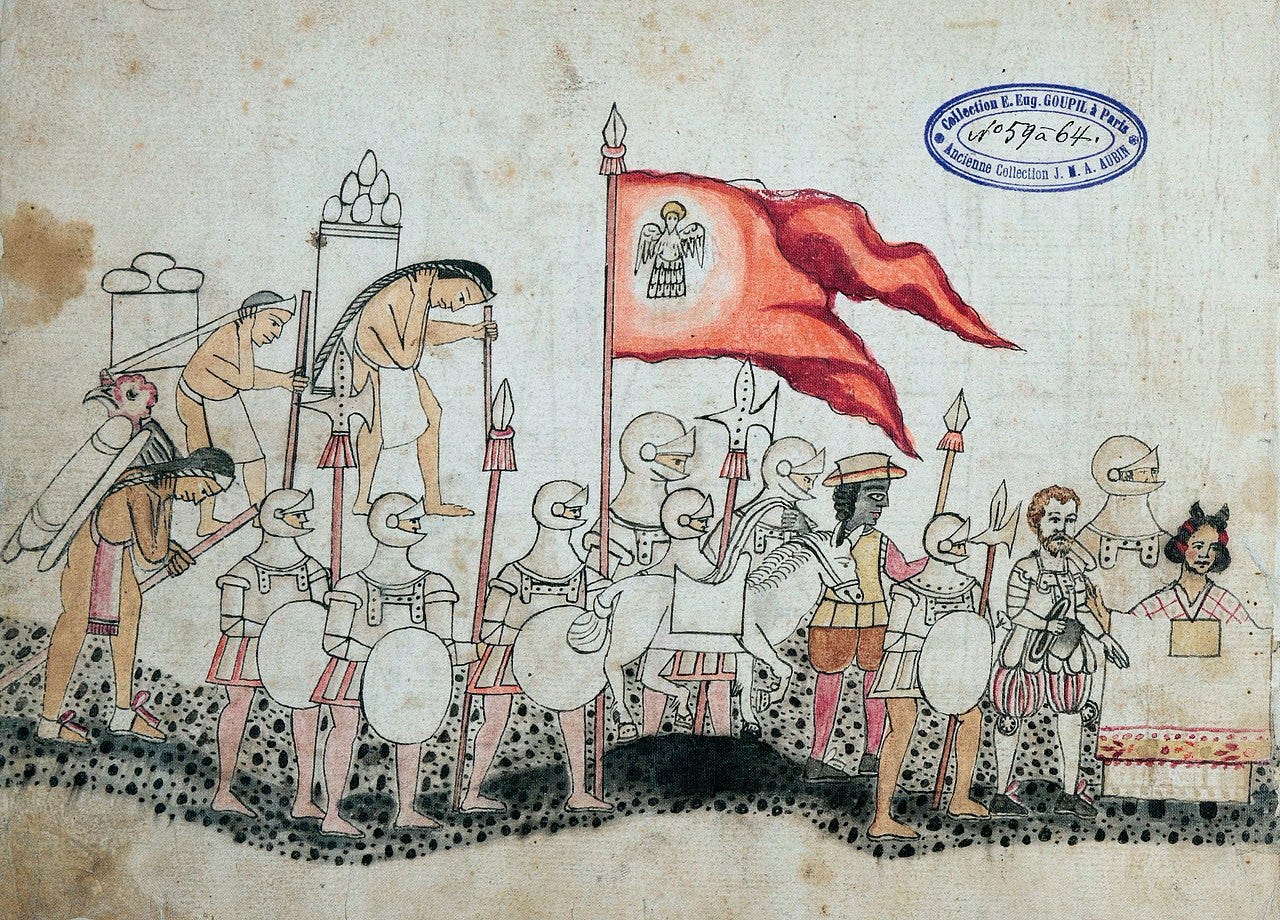
Columbus’s ships are how Atahualpa eventually crosses the Ocean Sea, but the most significant part of his story is his brief friendship with young Higuénamota. She learns Spanish from their conversations, and she never forgets his tales of an unknown land far to the east. It’s her imagination that points the way for Atahualpa, and her abilities as a translator that make his rise to power possible. She is valued, powerful, and in control, which is the opposite of the image passed down to us of real colonial translators like Malintzin/la Malinche, the enslaved girl who translated for Cortés in Mexico and is now remembered as a sexualized traitor. Here, Columbus himself occupies the stereotypical Malinche role, of translation as passivity and humiliation, which opens the door for Higuénamota’s self-possession and fearlessness. I think the real Malintzin must have been just as brave and curious as Higuénamota, even though history rarely grants her any agency. I love how the book puts translators at the center of history rather than relegating them to supporting roles.
ADH: That’s it for part one! We’re finding we have enough to say about the book to do this in multiple newsletters, week by week. As I said above, if you want to follow along, next week we’ll start covering “The Chronicles of Atahualpa” that make up the bulk of the book, up through the chapter titled “Cádiz” which ends on page 138 in the English language hardback edition. Thanks for reading and thinking about this fascinating text with us!
Absence: A Novel Arriving May 5!
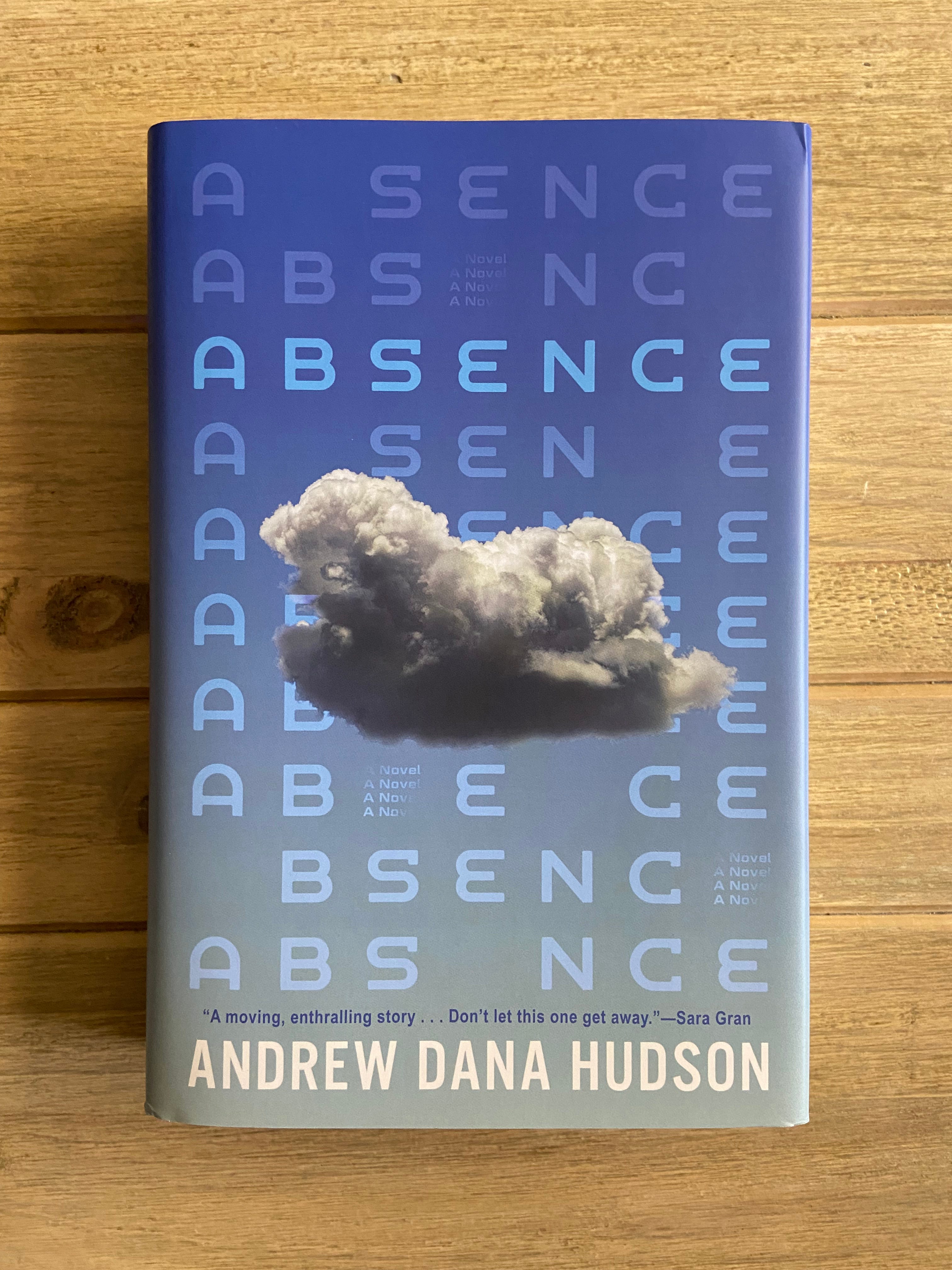
If you like books about the tender balance between structure and contingency that moves history, preorder my novel Absence, which comes out in less than two months from Soho Press.
I was away at AWP this week when a box of the actual book - hardback, jacket, and all - arrived. It looks great, with a back full of lovely blurbs. And a lovely new blurb just arrived this week from the incomparable Karen Joy Fowler:
“Hudson’s debut novel succeeds on every level – an original and compelling mystery, told with assurance, intelligence, craft, and all of it fueled by an extraordinary imagination.”
– Karen Joy Fowler
Book tour is starting to come together. I’ll be kicking things off in Phoenix with a pre-premier launch on Monday, April 27, 7pm at Changing Hands Bookstore. I’ll be talking about the book with my wonderful friend Matt Bell. If you are in the area, please come out!
Then on May 6th, I’ll be at Poison Pen in Scottsdale, signing and talking with another wonderful friend, Hayden Casey.
More should crystalize soon, most likely an NYC event in mid-May, and hopefully Bay Area and STL events and more later in the summer. If you read this newsletter and think we could turn out a crowd in your area, let me know!
Preorder your copy of Absence here or at your local bookstore!
Art Tour: Truthiness
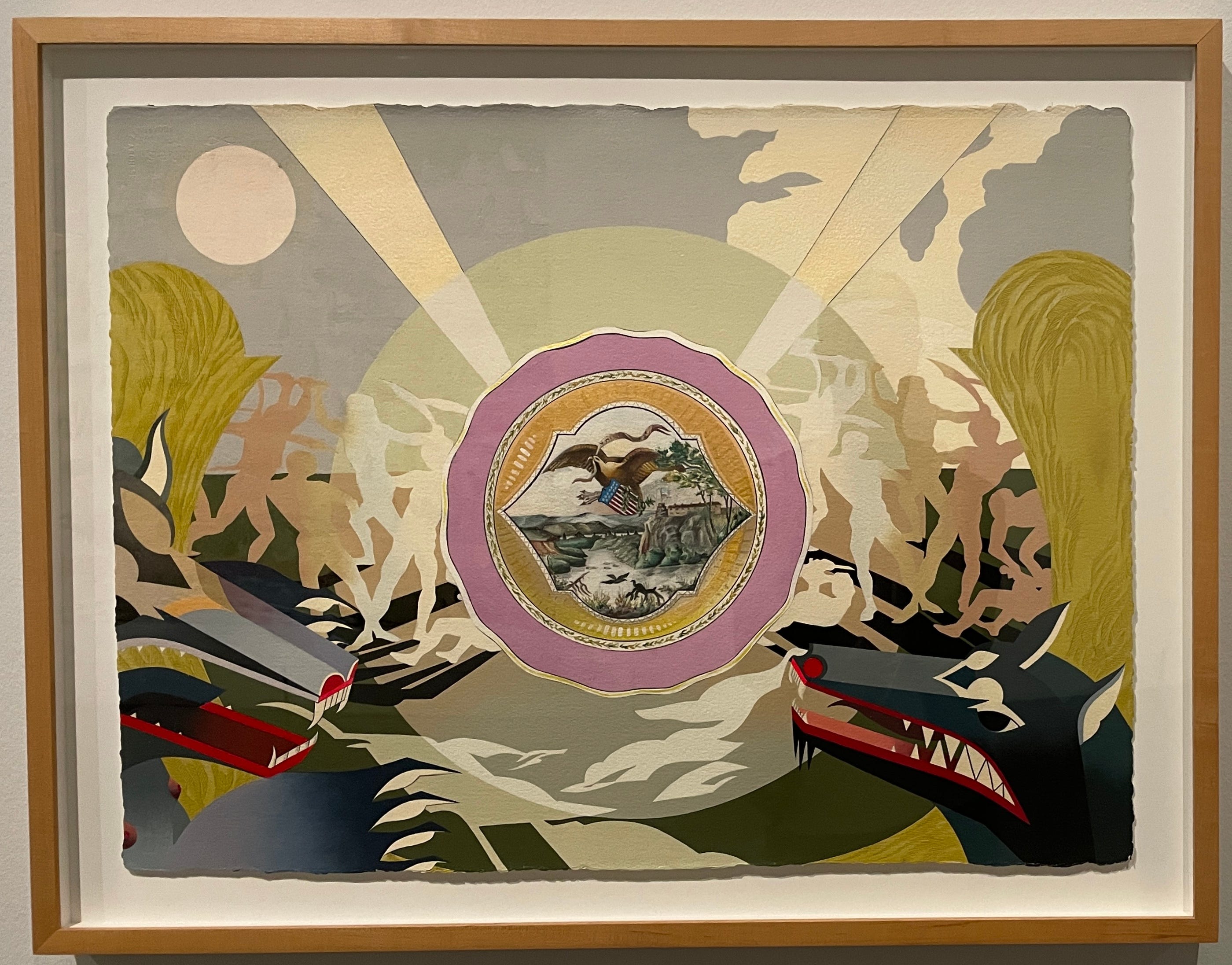
In Denver a few months ago, we saw a massive Andrea Carlson exhibit. It was the kind of show that makes you rush to the gift shop to buy the book version, which we did. Carlson describes herself as descended from Grand Portage Ojibwe and European settlers. Her kaleidoscopic mixed media works, like this one, seem to me to capture the chaotic, violent strangeness of American cultural landscapes and colonial history — and thus make a perfect companion to the above book club.
Congrats on your debut novel Andrew!