

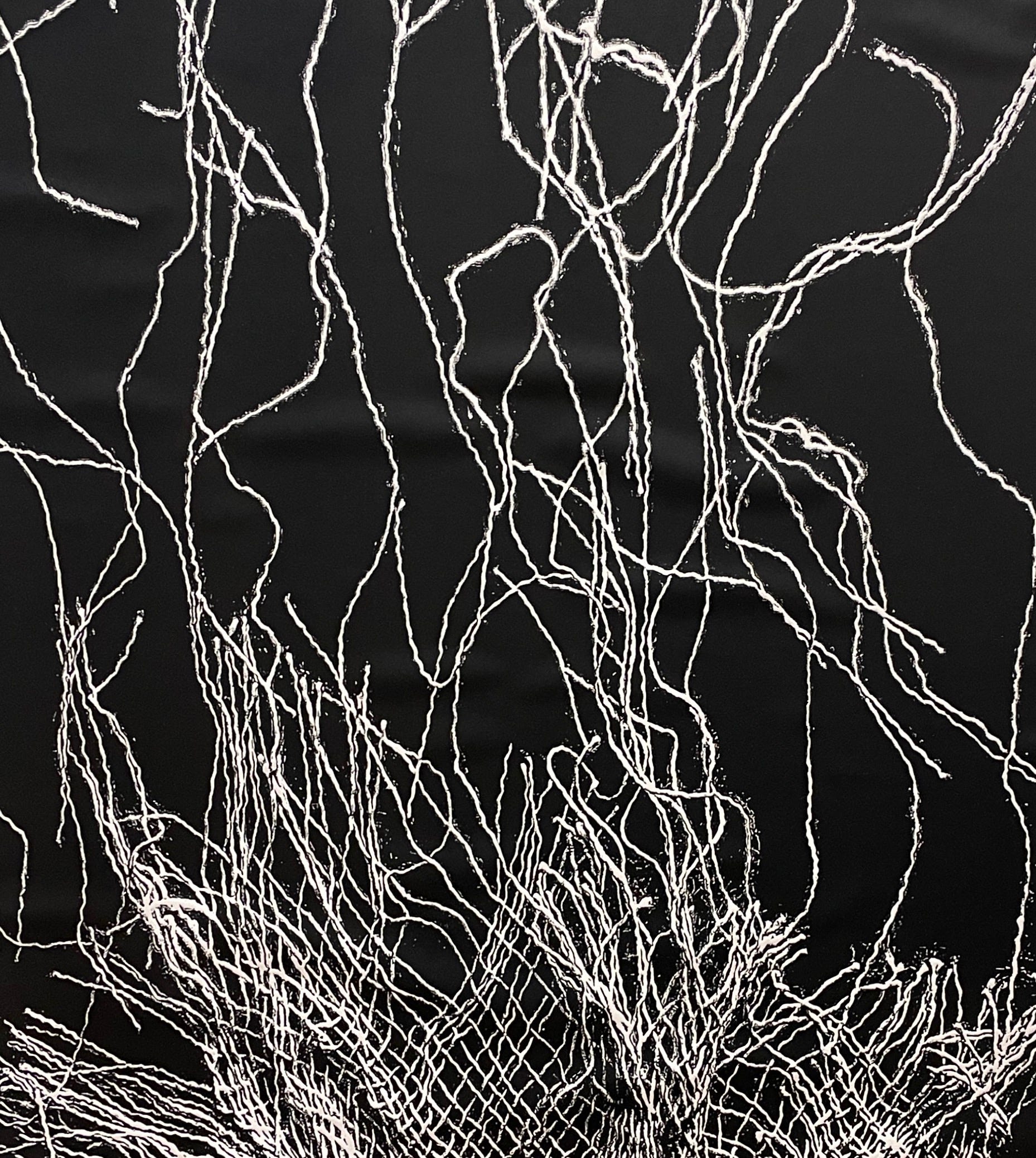
A couple years ago, I attended the premier of the documentary Roots So Deep (You Can See the Devil Down There), which explores a regenerative agriculture practice called “adaptive multi-paddock grazing,” or AMP. In AMP, instead of having cattle graze across a wide open field, you section the field off into smaller paddocks. You have the animals graze just in one section for a short time (not long enough to eat everything), then you move them onto a new section, allowing that bit of land to rest and regrow. The documentarians had several sets of farmers with adjacent land do trials, so they could compare AMP vs. conventional grazing’s impacts on soil health, cattle health, and the local ecosystem. The results were pretty clear. AMP grazing was better on every metric, and actually restored and built soil carbon, pulling atmospheric CO2 down into the ground in the form of organic matter — the eponymous roots.
What really struck me, though, was that AMP was designed to mimic the land-sculpting movements of the great buffalo herds that once roamed the Great Plains. Back before fences and farmers, buffalo were free to go where they wished, but also had to fear predators like wolves, which kept them bunched tightly together. This dense clustering is the key as much as giving the paddock time to rest, for it results in the animals better fertilizing the soil with their waste and better trampling the grasses and seeds down into the soil with their hooves.
It was such a powerful image, that after the screening I asked the director, Peter Byck, if he could imagine bringing the buffalo back as an autonomous force, instead of doing their regenerative work piecemeal with cows we raise for meat and dairy production. No, he told me, the land is all enclosed now, owned by thousands of farmers and ranchers and corporations, fenced into pieces, criss-crossed by highways and interstates. It’s never going back.
Which is probably true, but to me this felt like a challenge. Would it be that wild to make the land a little more wild? Whenever I hear that some unfortunate genie just won’t fit back in his bottle, I get that speculative itch. Why can we imagine colonizing distant planets and star systems, but we can’t imagine taking down some fences and voiding some deeds? Land reform and redistribution is a millennia-old political activity, and only our Jamesonian tendency to imagine the end of the world more readily than the end of capitalism makes enclosure feel permanent.
A while later I had a workshop deadline, and I’d recently read Charles Baxter’s essay “Against Epiphanies” (annoying Scribd link), and I was generally feeling ornery, so I decided to buck Byck’s analysis and Baxter’s craft advice and write an epiphany story that put buffalo back in the west. In one frenetic evening, I wrote a short piece titled “Namerica, Your Experience Continues,” about a wannabe journalist encountering a vast buffalo herd on a road trip through a borderless, de-enclosed future. That story just came out yesterday in the second issue of a cli-fi journal called Calyx. You can read it here.
The opening bit goes like this:
Did I ever tell you about the first time I saw the million?
I was a ways out of Chugwater when the Kessler weather got bad. Bad enough that my stream went dead, and the car nearly bricked, and for the first time in my long trip down the great Namerican highway, I had to get in the front and just drive.
Later I’d find out that an old spy satellite had clipped a lightfarm, and the whole northern hemisphere had gone to shit. For an hour or so my car kept jerking to a halt as navsats drifted below the horizon or — who knows? — shattered in a storm of orbital debris. I lay curled in the back, fighting down carsick, trying not to think about the too-close vibration of big trucks passing, whether a bad packet might nudge their steering a few inches to the left.
Finally I couldn’t stand it anymore. I had the car pull over onto the bramble-grassed shoulder, and I got out and stretched, wafting day-old nest-stink from my shirt. And there it was, all around me: Namerica, as wide and flat and big-skyed as promised.
The title, “Your Experience Continues,” was something I actually heard turning on the radio in the middle of nowhere, back on some pandemic camping trip. Day by pleasant day, year by maddening year, our experience really do continue!
The story features self-driving cars and ubiquitous social streaming and all that futuristic bric-a-brac, but the central speculative conceit is “De-enclosure.” “Enclosure” of course was the process by which, especially in England but also around the world, public lands that commoners could use for hunting, gathering, and grazing were, acre by acre, converted into privately owned farms and estates. In this future, they did the opposite, they erased borders and re-commoned land and set about taking down the barbed wire and the fences, all (it’s implied) part of a grand and revolutionary political and economic shift that swaps private property for a public goods system that provides for all.
Of course, not everyone is happy with that, and our narrator encounters some discontents on his journey.
A few had been put out by the buyouts, which seemed to them insufficient compensation for losing the feeling that thousands of acres were theirs and theirs alone. Others were jealous of those ranchers and farmers who had gotten buyouts, who’d taken the money and run to big cities or better pastures. Or they worried that without owned-land to pass on, they’d have no way to make their children stay. Or they resented the tribes and First Nations leading the stewardship of Namerican ecosystems, that old racial animus still rearing its noxious head. Or they simply felt dislocated by the changes, the commoning of responsibilities, the people and wildlife now able to roam through, the opening up of the box into which they had once snugly fit.
As the day rubbed away, and with it the novelty of driving, of feeling the heft of the car respond to the press of my foot, I began to feel that those angsty locals had a point. Don’t we, after all, triangulate our selves by the map-lines around us and the positions of our neighbors? Hadn’t civilization been a long process of dividing and subdividing the world into places, naming and documenting them, and, yes, fighting over who got which. But still, hadn’t this been one of the figuring out efforts, to which I was so drawn? Who was it for, this land without differentiation?
And then, lost in the wild and unending Namerican night, he drives into a million-strong buffalo herd. Go check out the story if you want to get to the epiphany.
Recently I revisited a bunch of Le Guin stories as part of the curriculum development work ASU has me doing. This got me thinking how, for me at least, speculative fiction is so much more interesting and powerful when it doesn’t just extrapolate on our expectations about the future but challenges them, shows us other ways humans might be. Sometimes such stories come out naive and utopian, or twist themselves around to undermine their own transformations. Still, I think it’s essential that SF attempt this effort of questioning the assumptions that stop up and foreclose our political imagination.
What if every empty genie bottle and opened pandora box contains within it the seeds and shape of its own reversal, one that has the potential to flow with the same inertia? (That’s dialectics, baby!) Chattel slavery embedded itself into the American economy so deep that many who disapproved of slaveholding still believed it would be too costly and complicated to ever extract. But emancipation had its own momentum, its own uncorking, and once accomplished it felt inevitable and unshakeable (if, in many ways, incomplete). So too with a lot of ratcheting progress and liberation, until reaction and fascism gets its hand on the steering wheel for a while and jerks us onto some awkward and bumpy road of reversal, and we have to fight our way back to the front of the bus. That’s history for you, long arc and all.
Could we ever accomplish De-enclosure? Can we erase borders once they are drawn, challenge property claims once they are made? Can we banish the unleashed demons of AI? Can we put gigatons of burnt carbon back in the ground, back in the soil, trampled down by countless heavy feet? I don’t know. But it seems much more interesting to try.
Future Frames: ARCO vs. Alice
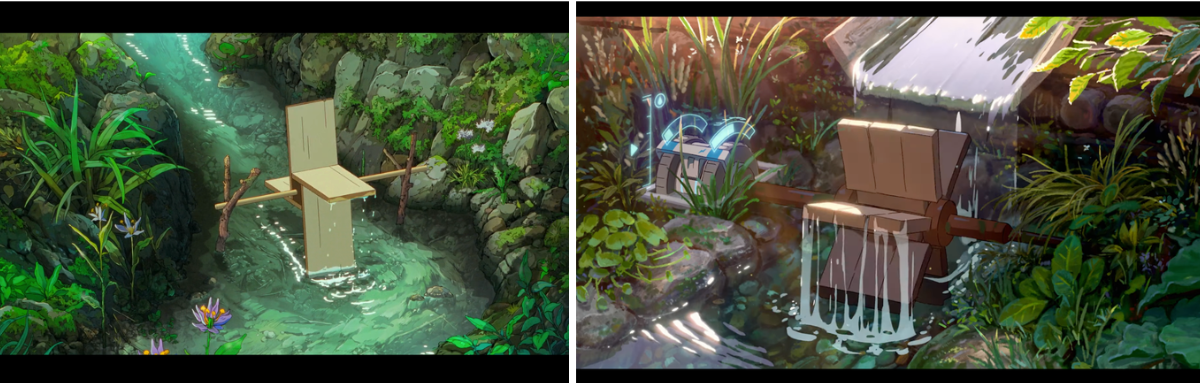
Back in August (this newsletter was delayed by Circumstances) I contributed a short essay to the Imaginary Papers newsletter, put out by my longtime friends and collaborators at ASU’s Center for Science and the Imagination. I wrote for their “Future Frames” series that examines a work of visual sci-fi through the lens of a single frame. My essay looks at the French animated sci-fi film Arco and the ways Solarpunk aesthetics and ideas have started to show up in film and beyond. It’s a fun film, and worth a watch, and then a read of my essay.
Coming in 2027: Residuals
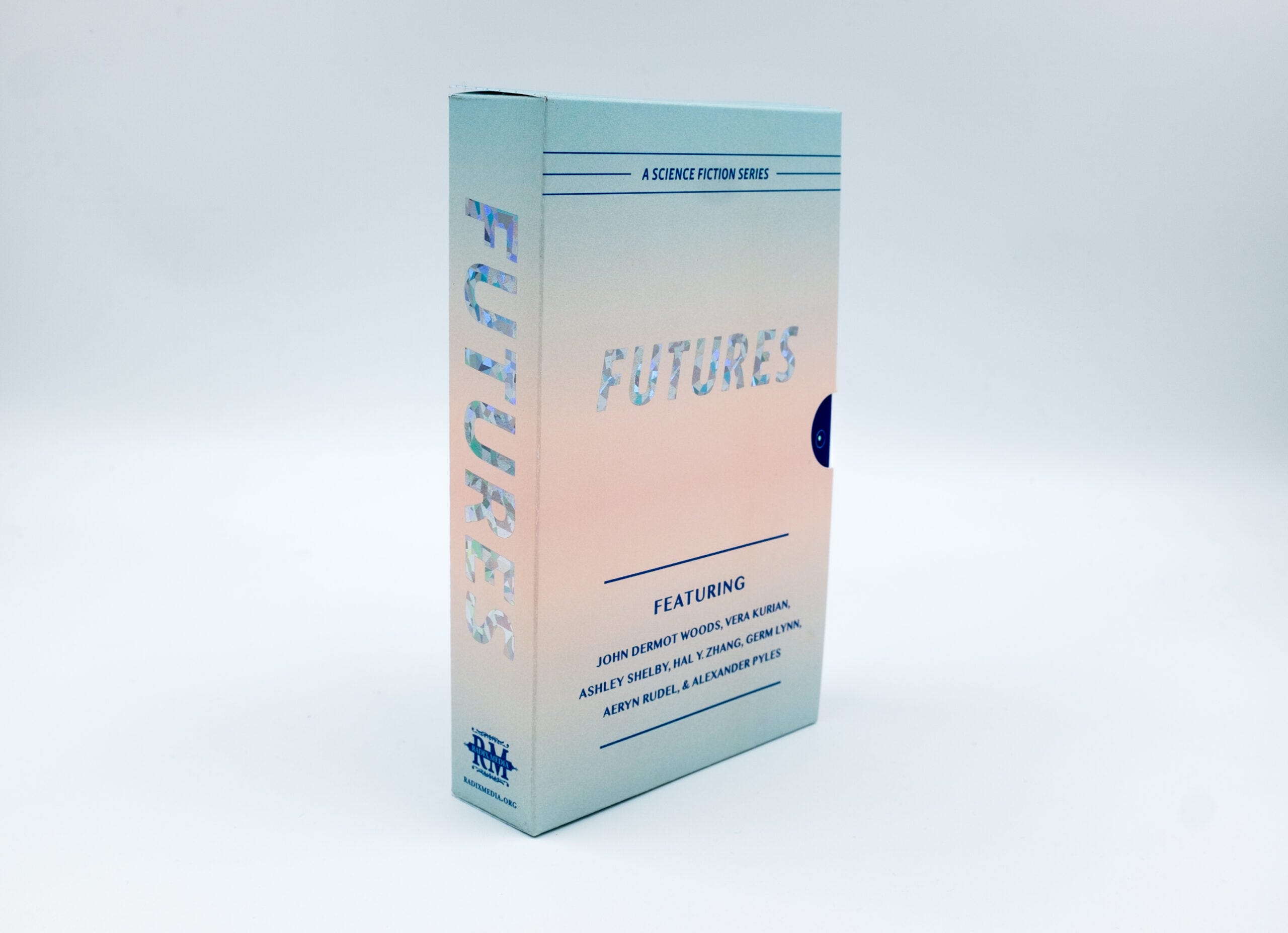
Excited to announce that a piece of mine has been selected for inclusion in the second volume of the Futures chapbook series, published by RADIX Co-op, a worker-owned, union print shop and publisher in Brooklyn. The story, Residuals, is one of my favorites, and also recently came in second in the 64th Glendon and Kathryn Swarthout Awards in Writing. I’m so happy this piece has found such a great home, and I’m giddy to share it with you all.
Residuals follows the scion of a cryogenics company, who handles the legal side of freezing trillionaires into dreaming immortality. It’s a noir-ish family drama that also sprawls across the climate-wracked continent, and across the various people the sleeping oligarchs leave behind.
The story itself will be published as an illustrated chapbook in about a year, which will be collected with the rest of the series into a box set. Keep an eye out this fall for a kickstarter campaign — that will probably be the best way to preorder.
Also in 2027: “The Gibson Continuum”
Another story of mine coming next year is “The Gibson Continuum,” a cyberprole riff on William Gibson’s classic story “The Gernsback Continuum” that I cowrote with with Aussie SFFH writer Corey Jae White. Look for it around March from the excellent Trollbreath Magazine.
Art Tour: Samira Hemmat
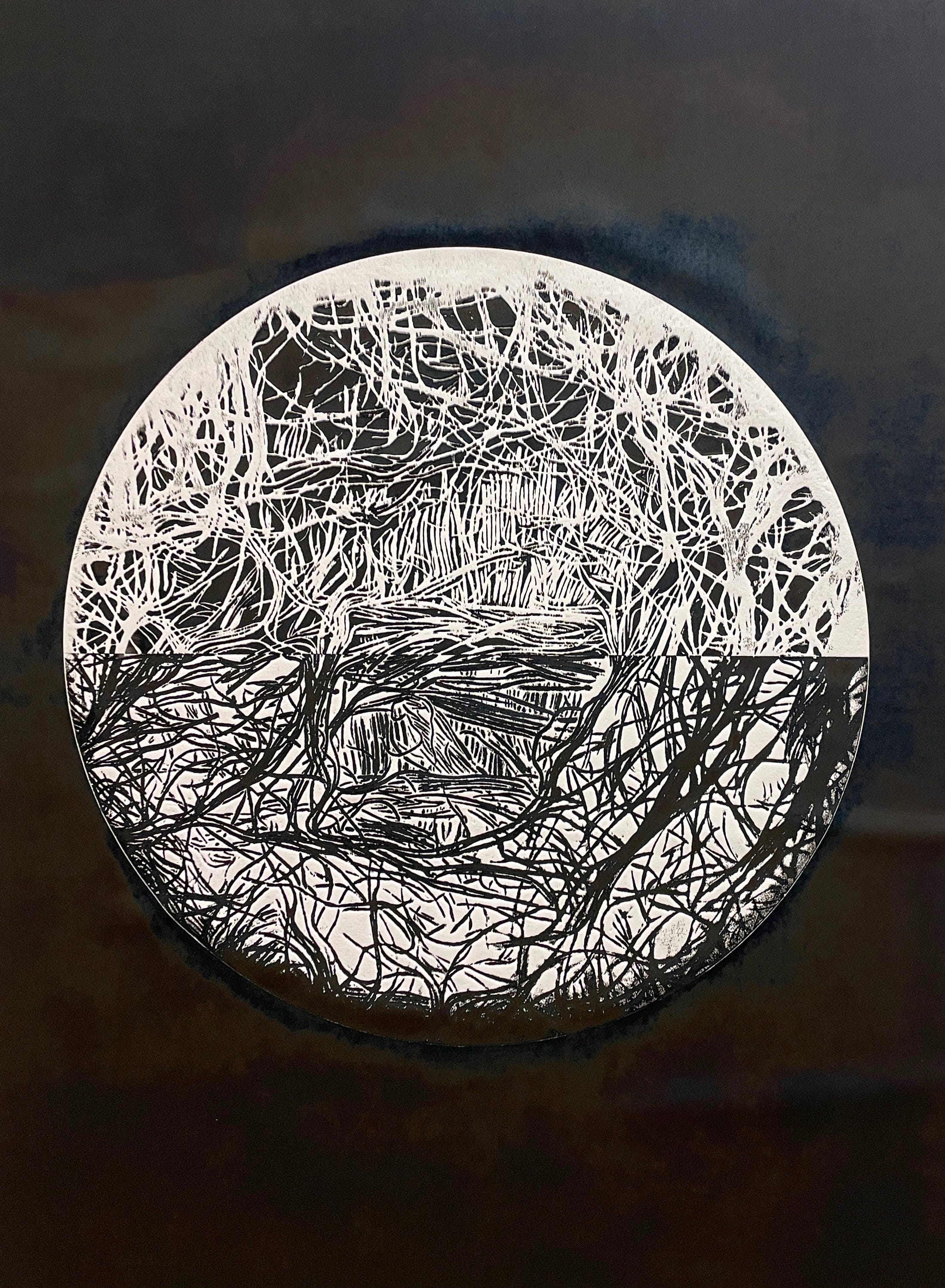
Got together with some writer friends recently to visit the opening night of new exhibitions at the often excellent Mesa Contemporary Art Museum. This exhibit, by Samira Hemmat, was particularly striking.
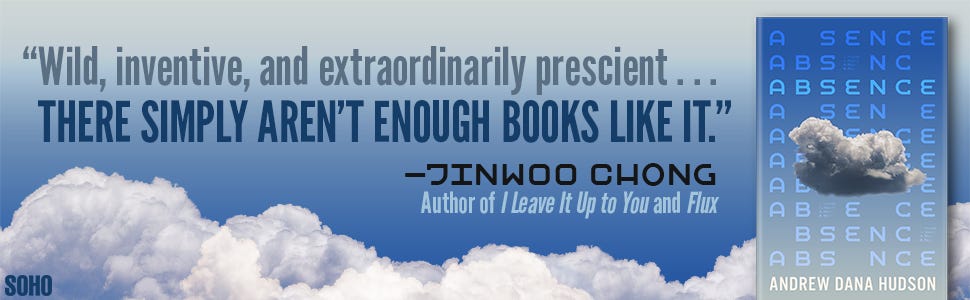
Thank you for reading. If you like what you read or want to support my work, please consider buying a copy of my novel Absence, a twisty speculative thriller. And if you’ve already read it (thank you!!), consider leaving a review at Goodreads, Amazon, etc., or maybe just letting your local bookstore know you liked it.