

One of my abiding interests is how narratives about the future, particularly as found in science fiction, interface with actually unfolding history. Which narratives turn out right, which turn out wrong. Which ones influence our present, and how, and should they. Are sci-fi stories useful at all when it comes to thinking about the future? This is why in many bios I call myself a “critical futurist”: as in, one who critically studies narratives about the future.
Earlier this year I wrote that, according to many of our traditional sci-fi signifiers of futurity, we were now living in The Future. As in, there are technologies and services that now exist, and news stories scrolling across chyrons, that a few decades ago would have been used in a sci-fi novel or movie to quickly show the audience that the story was set in the future. One of the most surreal aspects of this situation is tracking how different it feels to actually live through these events and with these technologies, compared to how I would have expected to feel, or how the characters in those sci-fi stories felt.
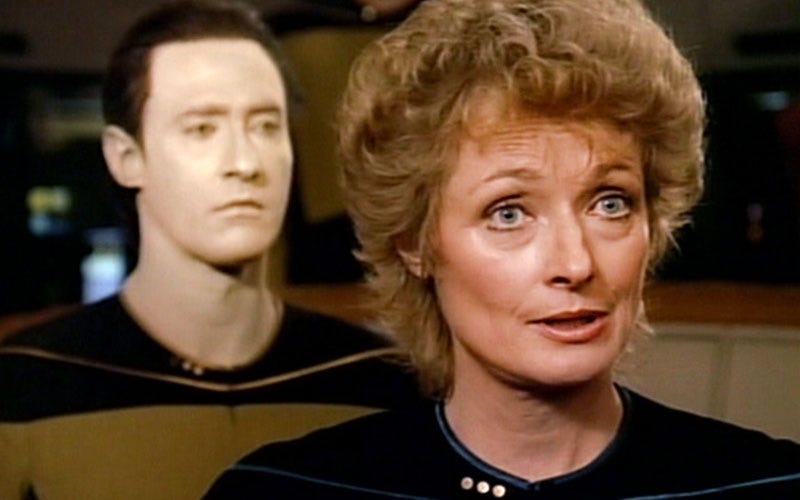
Consider the case of Dr. Katherine Pulaski from Star Trek: The Next Generation. Brought in after season one to stir the too-often-placid workplace pot, Pulaski, played by Diana Muldaur, is mostly remembered for her adversarial (and often rude) interactions with the android Commander Data. This made Pulaski something of a heel, probably contributing to her exit after the end of season two. After all, Data is a much-beloved character, and his efforts to understand humanity and become more human are both one of the most memorable arcs in the series and a classic example of the Pinocchio narratives common in SF about AI. I remember the indignation I once felt on Data’s behalf as Pulaski questioned his competency, mispronounced his name, and disputed his personhood. Nowadays, however, I rewatch those scenes and think, Pulaski has a point.
Now that our lives are swamped by artificial intelligence products much less reliable and angelic than Commander Data, Pulaski’s AI skepticism feels a lot more relatable. She’s out here with “What Is It Like to Be a Bat?” author Thomas Nagel, holding the line for humanity against systems that use language to give the false appearance of consciousness. Meanwhile her coworkers are all charmed by the sycophantic bot, particularly the IT guys (Geordi) and the C-Suite (Picard). Truly a parable for our time! Including, perhaps, Pulaski’s arc being one of softening and accommodation toward Data’s supposed humanity due to peer pressure and stern directives from her superiors.
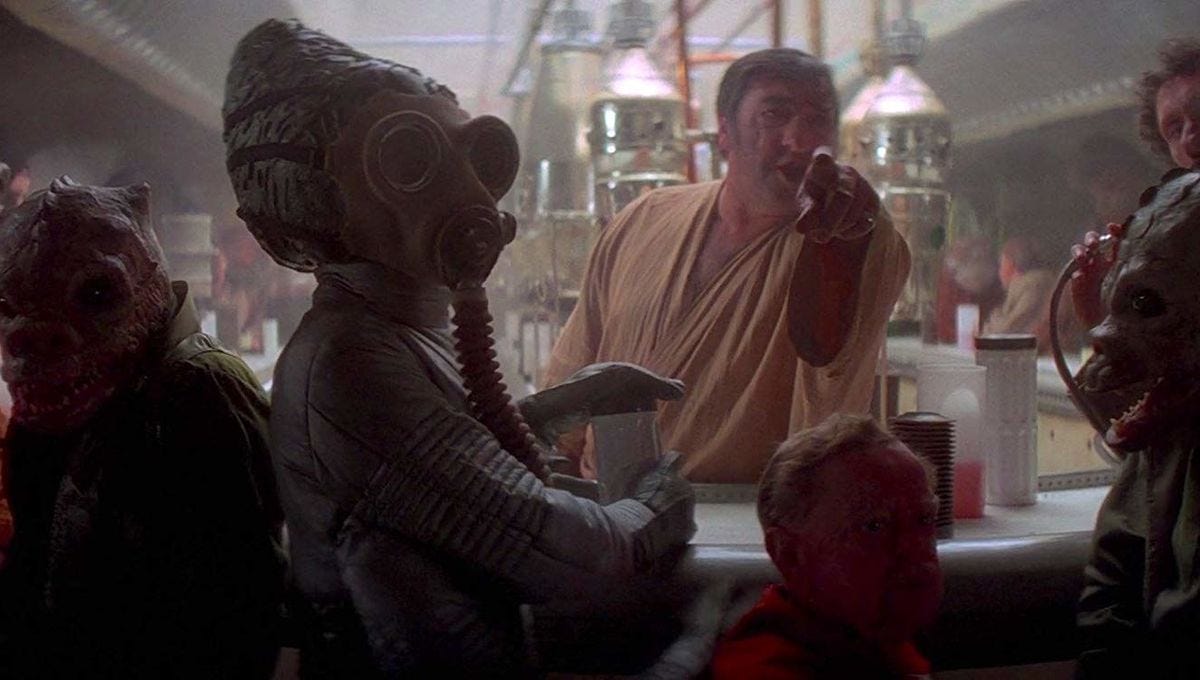
Pulaski fits into an archetype that appears a lot in SF: that of the techno-skeptic bot-hater. Think the cantina bartender who goes “we don’t serve their kind here” to the droids in Star Wars: A New Hope. These figures are usually very thinly-veiled stand-ins for real-life discrimination against various others. After all, sci-fi is often more a form of commentary on the time and place in which it was written than a forecast of the future, and we’ve seen quite a bit of this sort of prejudice over the last century+.
And yet, it turns out that, up close, the artifice of software pretending to be human is obvious, and it triggers, in some of us, a gut-level revulsion. This is not the reaction I would have personally guessed that I would experience had you asked me ten or twenty years ago. But when I revisit figures like Dr. Pulaski and, yes, even the droid-hating bartender, I find that I feel a lot of sympathy with their frustration and exasperation.
Who loves and who hates AI seem to be generally reversed from our SF-forged expectations. Among the pro-AI camp are many apparent cultural conservatives, and even evangelicals and other born again types (who could have predicted that?), as well as our 80-year-old president, who famously is so tech unsavvy he has Special Aides to print off social media posts for him. The anti-AI camp tends to be more progressive and secular (plus the Pope), and is full of young people frustrated with the mediated life tech has foisted on them.
Meanwhile the shrillest voices fretting about the existential dangers of AI are coming from the AI companies themselves, as well as (overlappingly) from a sex cult in Berkeley, California. Shouldn’t these people be reassuring the public about the safety of their products? Isn’t this all topsy-turvy?
Of course, anyone who has been following AI discourse knows there are strategic and positional and contingent reasons why various actors end up in one camp or another. Money buys loyalty, and big money is especially attractive to those who want to reify the social order, no matter where it comes from. There’s also the weird grift of AI-doom-as-marketing that few 20th century sci-fi writers predicted, and the competition between firms or between countries driving everyone to throw caution and good-sense to the wind. Meanwhile plenty of American liberals have been negatively polarized against the tech industry by the political activities of tech leaders, while the tech bros themselves have been polarized against their critics on the left. Nor are the coalitions so clean cut. As we saw in the midterms, where data centers took a beating across the country, AI is broadly unpopular with American voters regardless of party. However politicians of both parties (such Chuck Schumer or my own governor Katie Hobbs) have seen AI as an economic opportunity to secure for their constituents, or at least their campaign coffers.
But I think if you were to imagine a generic sci-fi novel from the 70s, 90s, or 2000s about the emergence of AI in the 2020s, you would sketch it out very differently. Conservatives and older people would be skeptical of the new technology that promises to swiftly change culture. Progressives who care about the marginalized would be sympathetic to the plight of the emerging AI underclass, rather than vociferously denying that the machines were anything more than gussied-up autocorrect. The Pope would still release an encyclical denouncing AI, but the progressive characters would shake their heads, not cheer. Mathematicians would be gleeful over fresh AI-generated math discoveries, rather than livid.
This is not to say that anyone is on the “wrong side” in this struggle. Mostly I think people have judged their situation correctly. Progressives see the potential of this tech to squeeze workers, empower authoritarians, and destroy truth, and they recoil. Fascists, meanwhile — well, I guess they see the same thing and get giddy.
What I’m curious about is: how did sci-fi get it so wrong?
Not sci-fi writers, per se; SFF authors today tend to be thoughtful and lucid critics of the tech industry and claims of AI consciousness. We’ve got Ted Chiang’s New Yorker essays, for instance, or this old Bruce Sterling talk that I think remains a banger, or my whole Bluesky feed. I attended a very militant “what is to be done”-style AI panel at World Fantasy Con last month. And, again, sci-fi in general is always best read as critical commentary on contemporary society, rather than actual predictions of what will come to pass.
But to the extent that there are predictions embedded in SF narratives — or better yet understandings of technology and societal response which may or may not prove out — I think it’s worth taking a moment to think about the shapes of those narratives. (I did a lot of reading and research to this effect back in 2018-19 as part of the AI Policy Futures project at ASU’s Center for Science and the Imagination.)
In pre-LLM SF stories you often see the following:
AI consciousness is coldly rational and struggles with emotion. In reality LLM chatbots are much defter at emotional affect than reliable reasoning, or even repeating back a number you’ve asked them to store.
AI will carry out its orders indefinitely in a hyper-literal way. Hence the “paperclip problem.” But it seems like LLMs and AI agents often struggle to stay on task, or may tell you they’ve done something that they haven’t indeed done. Hallucinations remain an issue. We’ve previously discussed how often AI tools don’t so much save time as transmute one person’s tedious writing task into another person’s tedious writing task.
AI is used as a metaphor for human social relations and struggles. Bots stood in for marginalized groups to tell stories about labor exploitation and civil rights. Today, however, AI tools are often sought out by bosses to give them leverage over workers, or by authoritarians to help them surveil their subjects and create propaganda. Meanwhile the emancipatory potential of this technology is unclear or in dispute.
Sci-fi stories tend to be about novel social change. Compared with fantasy, where the happy ending often involves the restoration of the rightful king to the throne, sci-fi stories often build up to moments of social or technological disjuncture that cannot be walked back. For better or worse, the narrative moves into the new. The protagonists of these stories (if not always the POV characters) are often agents of this novelty, while characters that resist the new are in the way of the inevitable narrative destination. (There are exceptions.) In real life, with real human lives, novelty is sometimes but not always better, and the “good guys” are just as likely to be resisters as they are pushers of novelty. Technological progress does not flow in one direction, and societies make choices about which technologies to pursue, countenance, and maintain. (See: humanity’s waffling over whether to adopt agriculture.)
All these guesses and narrative choices combine to create a murky blindspot. Add in other big SF misses, and one arrives at the sense that we’ve entered a futurity without a roadmap. Or, rather, with a number of bad maps that must be regarded skeptically or disregarded. And in a way this is liberating. We aren’t on rails. We get to make our own choices, if we have the courage.
Anyway, my European friends warn me that all this culture war over AI is mostly an American phenomenon, a proxy for our dissolving political settlement. Quite possibly! But I suspect the dissolution of a political settlement is when you find out what people really believe.
Some people — let’s call them Dr. Pulaskis — encounter AI and see the trick of it, the slop it produces, the hallucinations, the environmental cost, the plagiarism at its heart. Others — say, the Dr. Al-Hashimis — see an amazing future, or feel empowered by the tool’s apparent powers, or fall in love with the chatbot. It’s hard to always guess who is going to go which way. There’s plenty of cultural sorting around these questions, but I do think a big chunk of it is still a purely affective, or even spiritual response.
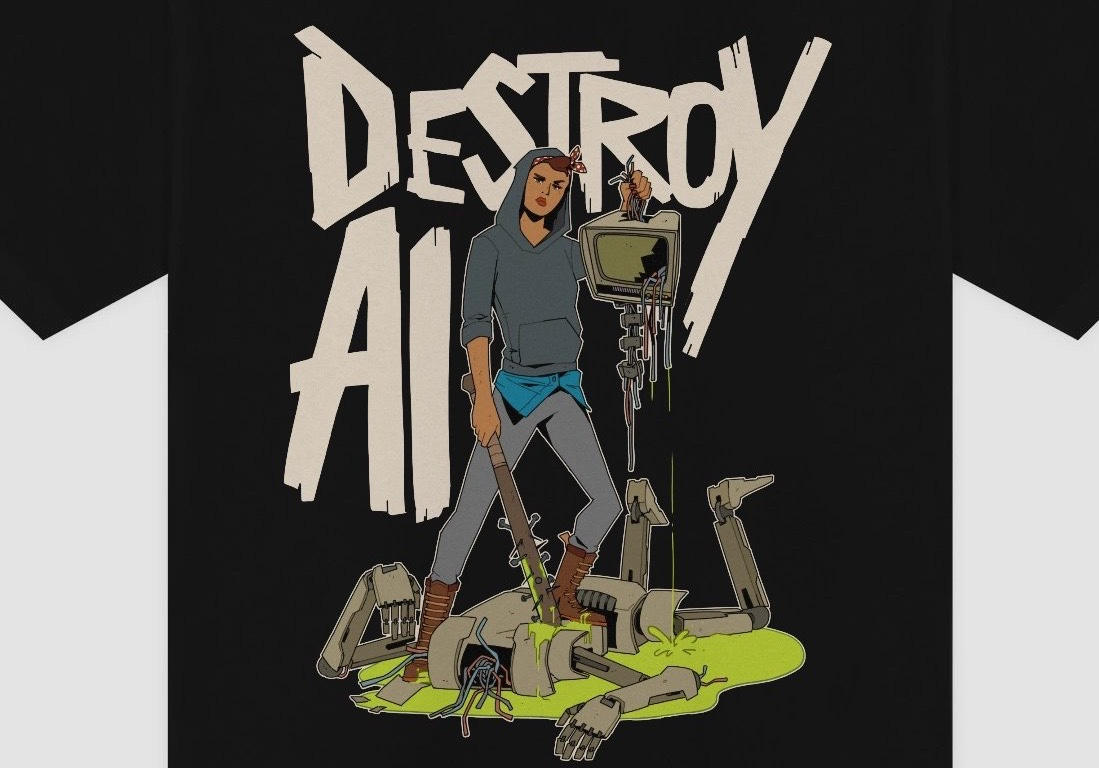
This is the AI risk I don’t hear AI safety people talking about: that these machines provoke wonder and adoration from some and frustration and disgust in others, and it is hard to see how these two groups can share a society.
Many people say AI isn’t going away, the genie is out. As discussed last month, I have my opinions about genies. But where does that leave those of us — possibly a majority of Americans, if you believe the exit polls! — who would prefer these products go away, or be severely curtailed in public life? How do democracy and the market accommodate that preference, as these society-shaping forces are supposed to do?
Well, as of Friday the market is cratering, and as of the midterms American democracy is undergoing the largest inertial shift in perhaps decades. However slow and blinkered the response, I think there will be one.
And when it comes, where does that leave those who really like this stuff? Are they willing to be like modern day smokers, relegated to the patio or the loading dock or a grim little box at the airport? Are they willing to be like heroin users, getting their fix from the black market? Or maybe they will accept being like the nuclear industry, wielders of a power so grimly dangerous that a vast complex of bureaucracy, both civilian and military, has grown up to contain it.
Maybe I’m being dramatic. Maybe over the next decade we’ll all learn to live with some AI, and systems and norms will be developed to mitigate the bad effects. My email’s spam filters are already starting to stem the tide of book club and publishing scams that have flooded every author’s inbox.
But, just like the odds the newly minted plutocrats at Anthropic are willing to give imminent human extinction, I give it about 25%. A 25% chance that AI will cause a social rift so unbridgeable, so hate-making, that the only recourse or one or both sides becomes violence. I really do think wars might be fought, civil and otherwise, over the right path on this technology. Or perhaps we will see Troubles everywhere, or the violent suppression of one side by the other. Here at the end of the end of history, we easily forget how much violent conflict has been driven not just by state competition but by ideology.
We joke about the Butlerian Jihad, but if there was large-scale conflict over AI, it wouldn’t be a matter of battling terminator-style evil robots. The combatants on both sides would be human, as would the casualties.
I take no pleasure in reporting this, as they say. But there is a sick thrill to imagining an industry that has been aggressively reducing quality of life for so many going up in flames, metaphorical or literal. And I know plenty of folks who, in their heart of hearts, wouldn’t mind being the one to toss the match.
I take some heart, though, in the humanistic frame I’ve seen brought to this debate as of late. We should ask the Amistic question of whether this or that technology actually serves human needs, enhances human life, makes us happier and more dignified through its use. And for the first time in a while, I see people asking that question about AI, and tech in general. Let’s hope it’s the start of a wiser way forward. It’s what Dr. Pulaski would want.
Absence in paperback is coming 4/6/27
Just got word this week that Soho Press is prepping the paperback edition of my novel Absence, with a scheduled release of April 6, 2027. For those who balk at hardback prices (understandable), this will hopefully be a chance to pick it up. For me, it’s nice to see a new set of blurbs rotated onto the cover, such as this starred review from Publishers Weekly:
Hudson gives a skillful metaphysical twist to a tale of apocalyptic horror in this strikingly original novel.
Or this one from the wonderful Karen Joy Fowler that is very near and dear to my heart:
An original and compelling mystery, told with assurance, intelligence, craft, and all of it fueled by an extraordinary imagination.
I’ll see about doing some more events to talk about it. If you’d like me to make an appearance at your local bookstore or library, please let me know!
You can preorder Absence in paperback here. And you can get it right now in hardback, ebook, and audiobook wherever books are sold.
News, Reviews + Miscellany
I’m in Phoenix Magazine’s Great 48! Each year Phoenix Magazine does a roundup of local notables in various fields, called The Great 48. (Because of the rhyme, Arizonans are keen to tout our place as the 48th state.) This year I was included on the list. I was featured among “the creatives,” which included musicians, artists, comedians, and dancers. It’s a fun little feature, and I’m honored to get to rep the valley’s literary community this year.
The always wise AC Wise recommended my recent story “Churn” in Locus Magazine as part of a review of the July/August issue of Analog.
Years back, just before the LLM turn, I did a project at ASU looking at the intersection of sci-fi narratives and AI policy. At the end we published some of our findings and insights in the journal AI & Society. Recently I’ve seen some renewed interest in this paper, including a presentation and discussion on a Youtube channel called the AI Governance Club. You can watch it here.
My short story “May Day,” originally published right here in this newsletter, will be reprinted in a coming anthology of time loop stories titled Opportunity Window, edited by Merc Fenn Wolfmoor. It’s a great looking TOC, and I’m stoked to be a part of it! Look for it in April of ‘27.
Art Tour: Mark Peoples
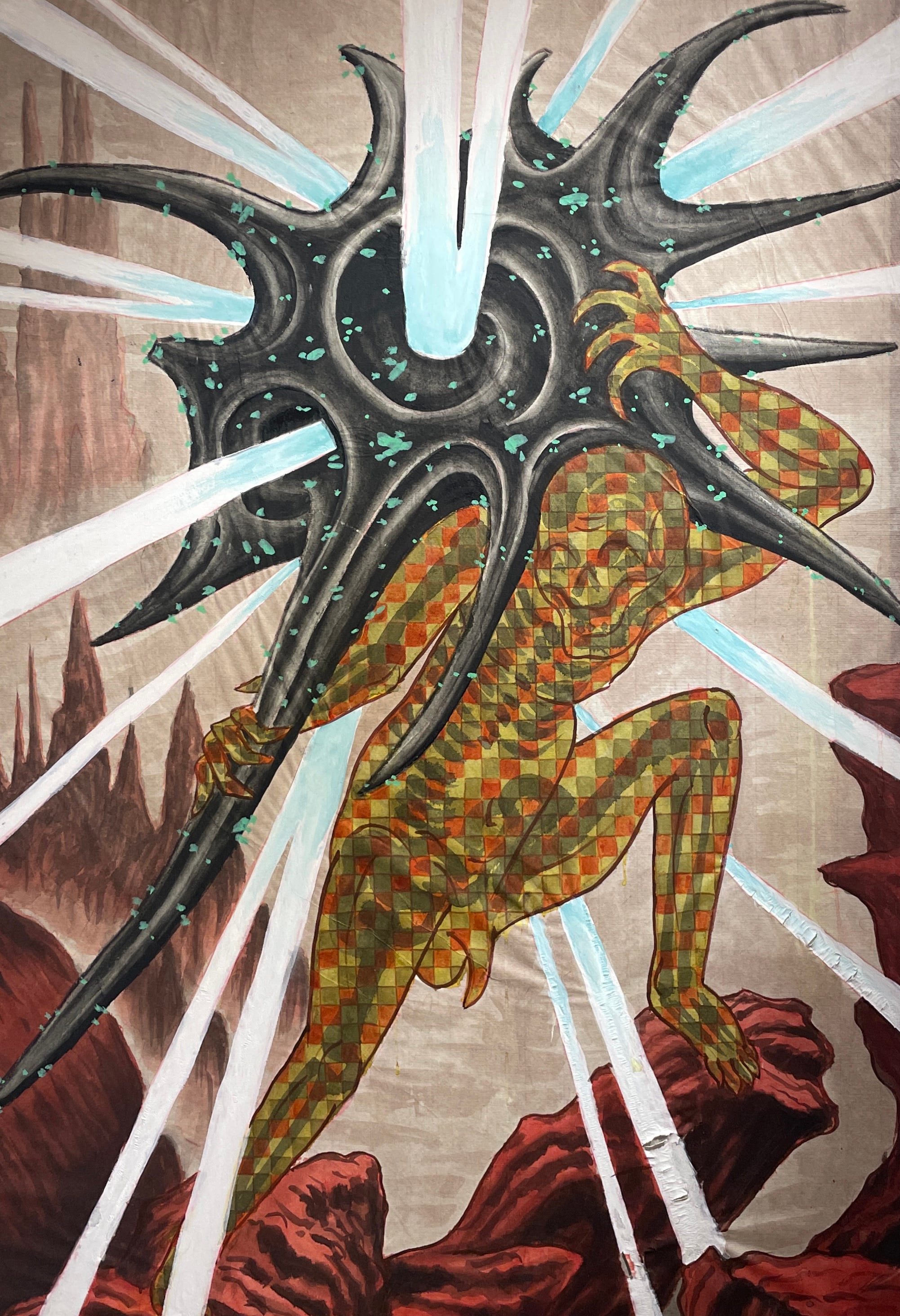
I saw this piece a few weeks ago at the opening of a new art gallery in my own neighborhood. A complex and checkered figure, wrestling with an alien shape of shining power. Is the thing an artifact or a living thing? Hard to say. Is he using it, or being crushed by it? What can I say — the piece just seemed appropriate.
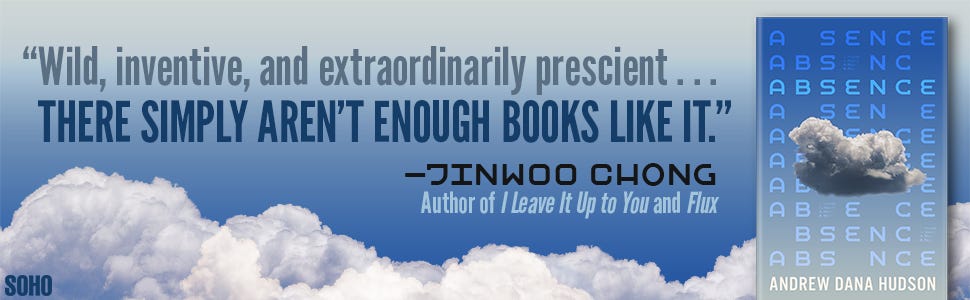
Thank you for reading. If you like what you read or want to support my work, please consider buying a copy of my novel Absence, a twisty speculative mystery. And if you’ve already read it (thank you!!), consider leaving a review at Goodreads, Amazon, etc., or maybe just letting your local bookstore know you liked it.